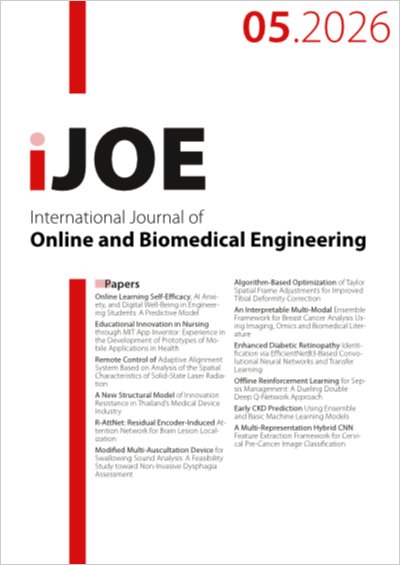
Online Learning Self-Efficacy, AI Anxiety, and Digital Well-Being in Engineering Students
A Predictive Model
DOI:
https://doi.org/10.3991/ijoe.v22i05.59863Keywords:
Online Learning Self-Efficacy (OLSE), AI Anxiety, Digital Well-Being, Engineering EducationAbstract
This study investigates the relationships among online learning self-efficacy (OLSE), artificial intelligence anxiety (AIA), and digital well-being (DWB) among undergraduate engineering students from six Jordanian universities (N = 428). Using validated self-report measures and a cross-sectional design, descriptive results indicated moderate OLSE (M = 3.24), moderately high AIA (M = 3.97), and moderate-to-low DWB (M = 2.41). A hypothesized mediation model was supported: OLSE was negatively associated with AIA (β = −0.64, p < .001) and positively associated with DWB (β = 0.52, p < .001), while AIA was negatively associated with DWB (β = −0.33, p < .001). The indirect effect of OLSE on DWB through reduced AIA was significant (β = 0.21, 95% CI [0.12, 0.34]), indicating partial mediation. The final model explained 76% of the variance in DWB. These findings highlight the importance of efficacy-building and AI-literacy supports to reduce AI-related anxiety and promote sustainable DWB in AI-enabled engineering education.
References
[1] Y.-P. Hsu et al., “Transforming engineering education in the digital era: Emerging technologies and digital innovations in technology-enhanced learning environments,” Frontiers in Education, vol. 10, Art. no. 1568917, 2025. https://doi.org/10.3389/feduc.2025.1568917
[2] J. Sanabria-Z. et al., “AI platform model on 4IR megatrend challenges: Complex thinking by active and transformational learning,” Interactive Technology and Smart Education, vol. 21, no. 4, pp. 571–589, 2024. https://doi.org/10.1108/ITSE-07-2023-0145
[3] M. A. Al Mamun et al., “Student mental health and academic motivation in the age of digital connectivity,” Social Sciences & Humanities Open, 2025. https://doi.org/10.1016/j.ssaho.2025.101927
[4] S. Coşkun, Y. Kayıkcı, and E. Gençay, “Adapting engineering education to Industry 4.0 vision,” Technologies, vol. 7, no. 1, Art. no. 10, 2019, https://doi.org/10.3390/technologies7010010
[5] B. J. White, H. Dent, and H. K. Fulk, “Generative artificial intelligence: Student learning, anxiety, and legality perceptions,” Issues in Information Systems, vol. 25, no. 4, pp. 61–77, 2024, https://doi.org/10.48009/4_iis_2024_105
[6] D. F. Mukhamedkarimova and M. M. Umurkulova, “Factors contributing to higher education students’ acceptance of artificial intelligence: A systematic review,” European Journal of Educational Research, vol. 14, no. 4, pp. 1373–1388, 2025. https://doi.org/10.12973/eu-jer.14.4.1373
[7] F. H. M. Bahar, “Digital well-being among learners in higher education: A scoping review,” MedEdPublish, vol. 16, no. 4, pp. 181–186, 2024. https://doi.org/10.21315/eimj2024.16.4.14
[8] R. Choudhuri, “More is not always better: Digital usage levels and psychological well-being among students,” International Journal of Scientific Research in Modern Science and Technology, vol. 5, no. 1, pp. 1–11, 2026. https://doi.org/10.59828/ijsrmst.v5i1.400
[9] K. Kaewpradit, P. Ngamchaliew, and N. Buathong, “Digital screen time usage, prevalence of excessive digital screen time, and its association with mental health, sleep quality, and academic performance among Southern University students,” Frontiers in Psychiatry, vol. 16, Art. no. 1535631, Mar. 2025, https://doi.org/10.3389/fpsyt.2025.1535631
[10] L. Zhang, S. Zhao, S. Zhao, Y. Ke, W. Yang, and M. Lei, “Association between the time of exposure to electronic screen and anxiety and depression after controlling demographics, exercises, and lifestyles among university students,” Neuropsychiatric Disease and Treatment, vol. 21, pp. 885–902, 2025, https://doi.org/10.2147/NDT.S510287
[11] F. Alfathyah, N. A. F. Faizal, A. D. N. Awalia, A. B. Kaswar, and M. M. Fakhri, “Digital balance in the AI era: A life-course perspective on AI interaction, digital well-being, and academic performance among engineering students,” AI in Learning, Language, Culture and Education, vol. 1, no. 1, pp. 1–15, 2024, https://doi.org/10.66053/aillce.v1i1.1
[12] C. Russo, L. Romano, D. Clemente, L. Iacovone, T. E. Gladwin, and A. Panno, “Gender differences in artificial intelligence: The role of artificial intelligence anxiety,” Frontiers in Psychology, vol. 16, art. 1559457, May 6, 2025, https://doi.org/10.3389/fpsyg.2025.1559457
[13] C. Chen, W. Hu, and X. Wei, “From anxiety to action: Exploring the impact of artificial intelligence anxiety and artificial intelligence self-efficacy on motivated learning of undergraduate students,” Interactive Learning Environments, vol. 33, no. 4, pp. 3162–3177, 2025. https://doi.org/10.1080/10494820.2024.2440877
[14] Y.-Y. Wang and Y.-S. Wang, “Development and validation of an artificial intelligence anxiety scale: An initial application in predicting motivated learning behavior,” Interactive Learning Environments, vol. 30, no. 4, pp. 619–634, 2022, https://doi.org/10.1080/10494820.2019.1674887
[15] A. Bandura, Self-Efficacy: The Exercise of Control. New York, NY, USA: Freeman, 1997.
[16] O. R. Riyanto, I. Muhammad, and N. H. Azmy, “Self-efficacy in online learning: A bibliometric analysis,” Journal of General Education and Humanities, vol. 4, no. 1, pp. 141–152, Feb. 6, 2025, https://doi.org/10.58421/gehu.v4i1.361
[17] M. Chen and C. Wu, “The impact of MOOC performance and the mediating effect of satisfaction with instructor and enjoyment of interaction on online learning self-efficacy in China,” American Journal of Distance Education, vol. 39, no. 4, pp. 491–507, 2025. https://doi.org/10.1080/08923647.2024.2393488
[18] A. I. Canhoto, D. Manika, E. Wainwright, and D.-M. Holder, “The impact of technology: How features, resources and task demands shape digital well-being,” Information Technology & People, ahead of print, pp. 1–24, Jun. 4, 2025, https://doi.org/10.1108/ITP-01-2024-0077
[19] European Commission JRC, Promoting Well-Being in Digital Education. EU Publications, 2025. https://doi.org/10.2760/4054846
[20] A. Frenkenberg and G. Hochman, “It’s scary to use it, it’s scary to refuse it: The psychological dimensions of AI adoption—anxiety, motives, and dependency,” Systems, vol. 13, no. 2, art. 82, Jan. 29, 2025, https://doi.org/10.3390/systems13020082
[21] M. I. Alkhawaja, M. S. A. Halim, and A. Afthanorhan, “Technology anxiety and its impact on e-learning system actual use in Jordan public universities during the Coronavirus Disease pandemic,” European Journal of Educational Research, vol. 10, no. 4, pp. 1639–1647, Sep. 2021, https://doi.org/10.12973/eu-jer.10.4.1639
[22] British Council and Ministry of Higher Education Jordan, Digital Transformation in Higher Education in Jordan. Amman, Jordan, 2020. Available: https: 20201213ecreport.pdf
[23] B. Q. Zheng and P. M. Bentler, “Enhancing model fit evaluation in SEM: Practical tips for optimizing chi-square tests,” Structural Equation Modeling: A Multidisciplinary Journal, vol. 32, no. 1, pp. 136–141, 2025. https://doi.org/10.1080/10705511.2024.2354802
[24] R. B. Kline, Principles and Practice of Structural Equation Modeling, 4th ed. New York, NY, USA: Guilford, 2015.
[25] J. F. Hair, B. J. Babin, R. E. Anderson, and W. C. Black, Multivariate Data Analysis, 8th ed. Boston, MA, USA: Cengage, 2019.
[26] P. Shea and T. Bidjerano, “Learning presence: Towards a theory of self-efficacy, self-regulation, and the development of a communities of inquiry in online and blended learning environments,” Computers & Education, vol. 55, no. 4, pp. 1721–1731, 2010. https://doi.org/10.1016/j.compedu.2010.07.017
[27] A. Zayed, “From digital distraction to self-regulated learning: Exploring the mediating role of digital resilience in adolescent students,” BSU Journal of Pedagogy and Curriculum, 2025. https://doi.org/10.21608/BSUJPC.2025.390444.1076
[28] S. A. Ithriah, D. Ridwandono, and T. L. M. Suryanto, “Online learning self-efficacy: The role in e-learning success,” Journal of Physics: Conference Series, vol. 1569, no. 2, art. 022053, 2020, https://doi.org/10.1088/1742-6596/1569/2/022053
[29] S. N. Neagu and A. M. Vieriu, “Digital and psychological well-being among technical university students: Exploring the impact of digital engagement in higher education,” Education Sciences, vol. 15, no. 9, Art. no. 1192, 2025. https://doi.org/10.3390/educsci15091192
[30] M. Naiseh, A. Babiker, S. Al-Shakhsi, D. Cemiloglu, D. Al-Thani, C. Montag, and R. Ali, “Attitudes towards AI: The interplay of self-efficacy, well-being, and competency,” Journal of Technology in Behavioral Science, vol. 10, pp. 705–718, Jan. 31, 2025, https://doi.org/10.1007/s41347-025-00486-2
[31] R. Nunkoo and H. Ramkissoon, “Structural equation modelling and regression analysis in tourism research,” Journal of Sustainable Tourism, vol. 20, no. 6, pp. 777–802, 2012, https://doi.org/10.1080/13683500.2011.641947
[32] J. C. Anderson and D. W. Gerbing, “Structural equation modeling in practice: A review and recommended two-step approach,” Psychological Bulletin, vol. 103, no. 3, pp. 411–423, 1988.
[33] C. M. Lockwood and D. P. MacKinnon, “Bootstrapping the standard error of the mediated effect,” in Proc. SAS Users Group Int., 1998, pp. 997–1002.
[34] V. B. Arslankara, A. Demir, Ö. Öztaş, and E. Usta, “Digital well-being scale validity and reliability study,” Journal of Teacher Education and Lifelong Learning, vol. 4, no. 2, pp. 263–274, 2022. https://doi.org/10.51535/tell.1206193
[35] M. Al-Nasa’h, L. Al-Tarawneh, F. M. Abu Awwad, and I. Ahmad, “Estimating students’ online learning satisfaction during COVID-19: A discriminant analysis,” Heliyon, vol. 7, no. 12, art. e08544, Dec. 2021, https://doi.org/10.1016/j.heliyon.2021.e08544
[36] L. Al-Tarawneh, M. Al-Nasa’h, and F. Abu Awwad, “The effect of the COVID-19 pandemic among undergraduate engineering students in Jordanian universities: Factors impact students’ learning satisfaction,” in Proc. 2021 Innovation and New Trends in Engineering, Science and Technology Education Conf. (IETSEC), May 16–18, 2021, https://doi.org/10.1109/IETSEC51476.2021.9440500
[37] A. Yasin, L. Al-Tarawneh, F. El-Issa, and A. Al-Zoubi, “Students’ achievement in an online course on technical writing and communication skills,” Interactive Technology and Smart Education, vol. 19, no. 4, pp. 526–543, 2022, https://doi.org/10.1108/ITSE-05-2022-0057
Downloads
Published
How to Cite
Issue
Section
License
Copyright (c) 2026 Mais Al-Nasa'h, Luae Al-Tarawneh, Esam A. AlQaralleh, Nizar Allabadi, Souad Ghaith, Sami Aldalahmeh

This work is licensed under a Creative Commons Attribution 4.0 International License.