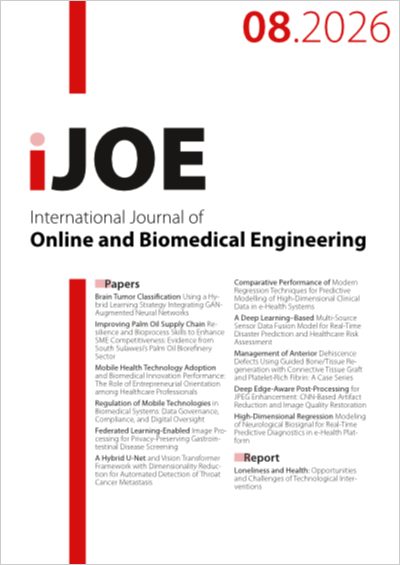
Improving Palm Oil Supply Chain Resilience and Bioprocess Skills to Enhance SME Competitiveness: Evidence from South Sulawesi’s Palm Oil Biorefinery Sector
DOI:
https://doi.org/10.3991/ijoe.v22i08.62317Keywords:
Supply Chain Resilience, Green Competitive Advantage, Bioprocess Skills, SME Performance, Palm Oil BiorefineryAbstract
This study examines how supply chain resilience (SCR) can improve sustainable business performance for small and medium enterprises in the palm oil biorefinery sector in South Sulawesi, Indonesia. It focuses on the roles of Green Competitive Advantage and Bioprocess Skills in influencing this relationship. The research uses survey data from 150 owners and managers of micro and small enterprises (MSE) in Makassar City, Gowa Regency, and ParePare City. The data were analysed with structural equation modelling (SEM) using IBM SPSS and AMOS 25. The findings show that SCR has a strong impact on green competitive advantage and bioprocess skills, but it does not directly improve sustainable SME business performance. Both green competitive advantage and bioprocess skills play a key role in boosting SME performance and fully explain how SCR affects business results. This means that having a resilient supply chain is not enough to improve SME performance unless it is combined with environmental competitiveness and strong bioprocess skills. The study points out that integrating resilient logistics, green operations, and technical engineering skills is important for improved sustainable performance in the palm oil biorefinery sector.
References
[1] Alkatiri, A. S., & Wardhana, A. (2026). Digital Accounting and Financial Performance of MSMEs in Indonesia: The Mediating Role of Digital Innovation. Journal of Risk and Financial Management, 14(3), 66. https://doi.org/10.3390/ijfs14030066
[2] Judijanto, L. (2026). Indonesia’s Mandatory B50 Biodiesel Policy Postponement in 2026: A Prudent Strategic Decision or Policy Setback? A Review. European Journal of Innovative Studies and Sustainability, 2(1), 208-228. https://doi.org/10.59324/ejiss.2026.2(1).14.
[3] Ali Ijaz Malik, M., Zeeshan, S., Khubaib, M., Ikram, A., Hussain, F., Yassin, H., & Qazi, A. (2024). A review of major trends, opportunities, and technical challenges in biodiesel production from waste sources. Energy Conversion and Management: X, 23, 100675. https://doi.org/10.1016/j.ecmx.2024.100675
[4] Asante-Darko, D., & Osei, V. (2024). Sustainable supply chain management practices and firm performance: the mediating effect of firm capabilities. Management of Environmental Quality: An International Journal, 35(4), 751-779
[5] Pono, M., Alam, S., & Munizu, M. (2020). The effect of supply chain strategy toward competitive advantage, and company performance: case of small-medium industries in West Sulawesi Province of Indonesia. Revista Espacios, 41(14).
[6] Munizu, M., Arsyad, M., & Munir, A. R. (2024, May). Digital marketing as a powerful tool to improve MSMEs performance. In 8th International Conference on Accounting, Management, and Economics (ICAME 2023) (pp. 380-393). Atlantis Press.
[7] Rozakis, S., Juvančič, L., & Kovacs, B. (2022). Bioeconomy for resilient post-COVID economies. Energies, 15(8), 2958.
[8] Asante-Darko, D., & Osei, V. (2024). Sustainable supply chain management practices and firm performance: the mediating effect of firm capabilities. Management of Environmental Quality: An International Journal, 35(4), 751-779
[9] Attia, A.M. (2016). Effect of Quality Management on Supply Chain and Organisational Performance in Egyptian Textile Industry. International Business Performance Management. Vo.17 No.2, pp.198-222
[10] Blome, C. Paularaj, A. & Schuetz, K. (2014). Supply Chain Collaboration and Sustainability: A Profile Deviation Analysis. International Journal of Operations & Production Management. Vol.34 No.5, pp.639-663
[11] Heinzle, E., Biwer, A. P., & Cooney, C. L. (2006). Development of sustainable bioprocesses: modeling and assessment (pp. 155-167). Chichester: John Wiley & Sons.
[12] Masudin, I., Ginanjar, B. W., Zulfikarijah, F., & Restuputri, D. P. (2026). The impact of green innovation-based and sustainable leadership on sustainability performance: a case of Indonesian furniture manufacturing industry. International Journal of Productivity and Performance Management, 1-27.
[13] Romagnoli, G., Galli, M., Mezzogori, D., & Reverberi, D. (2022). A Cooperative and Competitive Serious Game for Operations and Supply Chain Management: Didactical Concept and Final Evaluation. International Journal of Online and Biomedical Engineering (iJOE), 18(15), pp. 17–30. https://doi.org/10.3991/ijoe.v18i15.35089.
[14] Quttainah, M. A., Haque, S., Panda, D., & Rana, S. (2025). Industrial circular ecosystem entrant: examining small firms. Management Decision, 63(13), 46-65.
[15] Hair, J. F., Sarstedt, M., Ringle, C. M., & Mena, J. A. (2012). An assessment of the use of partial least squares structural equation modeling in marketing research. Journal of the academy of marketing science, 40(3), 414-433.
[16] Mohamad, M., Nii Laryeafio , M., Koroye, E., Nyame , D., Ayertey , S., & Emini , A. (2026). The Impact of AI-Powered Mobile Money System on Supply Chain: Multi-Cases from SMEs in the Global South. International Journal of Interactive Mobile Technologies (iJIM), 20(01), pp. 105–121. https://doi.org/10.3991/ijim.v20i01.59279
Downloads
Published
How to Cite
Issue
Section
License
Copyright (c) 2026 Maat Pono, Sabbar Dahham Sabbar, Musran Munizu, Mohamed Ibrahim Mugableh

This work is licensed under a Creative Commons Attribution 4.0 International License.