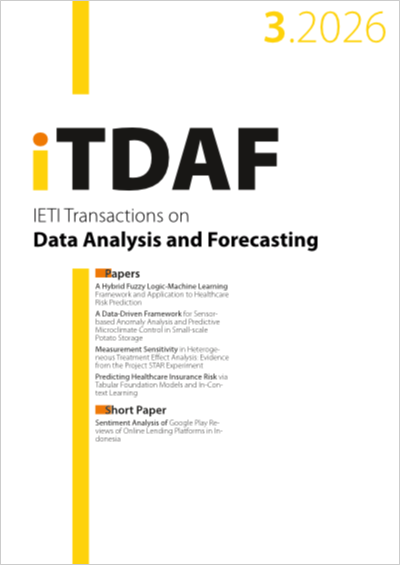
A Data-Driven Framework for Sensor-based Anomaly Analysis and Predictive Microclimate Control in Small-scale Potato Storage
DOI:
https://doi.org/10.3991/itdaf.v4i3.61867Keywords:
sensor data analysis, microclimate forecasting, anomaly detection, predictive control, digital twin, safe reinforcement learning, potato storage, cyber-physical systemAbstract
Postharvest losses during potato storage remain a serious problem, especially for small-scale storage facilities with limited automation, monitoring, and energy resources. This paper proposes a data-driven cyber-physical framework for sensor-based microclimate analysis and predictive management of small-scale potato storage facilities. The framework defines the integration of a physics-informed digital twin, a safe reinforcement learning controller formulated as a constrained Markov decision process (CMDP), and a multi-sensor anomaly detection module operating on multidimensional time-series sensor data. The proposed approach is aimed at analyzing microclimate dynamics, detecting abnormal changes in temperature, humidity, and gas composition, and supporting prediction-oriented control decisions under technological and energy constraints. The digital twin is intended to serve as a simulation environment for training and future evaluation of predictive control strategies without risk to stored products. The control formulation explicitly represents the trade-off between energy consumption and storage quality while considering constraints on temperature, relative humidity, oxygen, carbon dioxide, and spoilage-related gas indicators. A set of forecasting-oriented validation scenarios is defined, including normal operation, hypoxia, early biodegradation, sensor failures, and energy-constrained storage conditions. The work forms a methodological basis for subsequent quantitative simulation, sensor data analysis, and experimental validation on real potato storage facilities.
References
[1] Kitinoja L., Tokala V. and Mohammed M. (2019). Clean cold-chain development and the critical role. Agriculture for Development, 36, pp. 19-25.
[2] Tang X., Tan Ch., Chen A., Li Zh., Shuai R. Design and implementation of temperature and humidity monitoring system for small cold storage of fruit and vegetable based on Arduino. J. Phys.: Conf. Ser. 1601 062010. doi:10.1088/1742-6596/1601/6/062010.
[3] Yakubov S.Kh., Pirova R.K. (2021). Climate Management System in the Vegetable Storage of Perishing Agricultural Products. International Journal of Latest Engineering Research and Applications (IJLERA), V.06, Issue -09, pp. 24-32. ISSN: 2455-7137.
[4] Isakov A., Pirova R., Sodiqova F. (2023). Automatic control system for automatic maintenance of microclimate in vegetable storages. E3S Web of Conferences 458, 01012. https://doi.org/10.1051/e3sconf/202345801012.
[5] Zhen Q, Xu C, Tana, Wang H, Yue X, Yan C and Sun Y (2025). Research on the temperature and humidity distribution characteristics in potato storage facilities: experimental analysis and numerical simulation. Front. Sustain. Food Syst. 9:1594791. doi: 10.3389/fsufs.2025.1594791.
[6] Onwude D., Chen G., Eke-emezie N., Kabutey A., Alkhaled A., Sturm B. (2020). Recent Advances in Reducing Food Losses in the Supply Chain of Fresh Agricultural Produce. Processes, 8, 1431, www.mdpi.com/journal/processes, doi:10.3390/pr8111431
[7] Trotter Ph., Becker T., Renaldi R., Wang X., Khosla R., Walther G. (2023). The role of supply chains for the sustainability transformation of global food systems: A large‐scale, systematic review of food cold chains. Journal of Industrial Ecology 27 (7), pp. 1429 – 1446, DOI: 10.1111/jiec.13445
[8] Hoffmann, T. G., de Souza, C. K., Sonawane, A. D., et al. (2025). Challenges and future perspectives in postharvest cold storage: Technological review on sustainable and efficient cold storage of fresh produce. Food Research International, 117406. https://doi.org/10.1016/j.foodres.2025.117406
[9] Mohammed M., Riad K., Alqahtani N. (2022). Design of a Smart IoT-Based Control System for Remotely Managing Cold Storage Facilities. Sensors, 22(13):4680. DOI: 10.3390/s22134680
[10] Sher A., Khan U., Rafique M., Ikram A., Mazhar A. (2024). Development and analysis of a smart cold storage system for fruit warehouses. MATEC Web of Conferences 398, DOI: 10.1051/matecconf/202439801027
[11] Afreen H., Bajwa I. (2021). An IoT-Based Real-Time Intelligent Monitoring and Notification System of Cold Storage. IEEE Access PP(99):1-1, DOI: 10.1109/ACCESS.2021.3056672
[12] Krasnikova I.N., Simonov V.L., Petelin A.E. (2024). Features of development of an agricultural warehouse digital twin. BIO Web of Conferences 83, 03004. STDAIC-2023, https://doi.org/10.1051/bioconf/20248303004
[13] Hammerschmid M., Aguiari C., Kirnbauer F., Zerobin E., Brenner M., Eisl R., Nemeth J., Buchberger D., Ogris G., Kolroser R., Goia A., Beyweiss R., Kalch K., Müller S., Hofbauer H. (2023). Thermal Twin 4.0: Digital Support Tool for Optimizing Hazardous Waste Rotary Kiln Incineration Plants. Waste and Biomass Valorization, https://doi.org/10.1007/s12649-022-02028-w
[14] Wachi A., Xun Sh., Sui Y. (2024). A Survey of Constraint Formulations in Safe Reinforcement Learning. Conference: Thirty-Third International Joint Conference on Artificial Intelligence (IJCAI-24), pp.8262-8271. DOI: 10.24963/ijcai.2024/913.
[15] Bui V-H., Das S., Hussain A., Hollweg G., Su W. (2024). A Critical Review of Safe Reinforcement Learning Techniques in Smart Grid Applications. DOI: 10.48550/arXiv.2409.16256.
[16] Chatterjee A., Ahmed B.S. (2022). IoT Anomaly Detection Methods and Applications: A Survey. Elsevier, Internet of Things, 19, 100568.
[17] Sayed Kh., Abhinandana B., Broujeny, R.S., Beddiar K. (2024). Reinforcement learning for HVAC control in intelligent buildings: A technical and conceptual review. Journal of Building Engineering. 95. 110085. DOI: 10.1016/j.jobe.2024.110085.
[18] Pedrosa V., Izidoro M., Paythosh S. Dungan R., Olsen N., Spear R., Teixeira G. (2025). The Relationship Between Respiration Rate and Quality Parameters of Russet Potatoes During Long-Term Storage. American Journal of Potato Research, (102) 2, DOI: 10.1007/s12230-025-09977-7.
[19] Lin H., Wei Zh., Chen Ch., Huang Y., Zhu J. (2024). Early Identification of Rotten Potatoes Using an Electronic Nose Based on Feature Discretization and Ensemble Convolutional Neural Network. Sensors 24(10):3105, DOI: 10.3390/s24103105.
[20] Trilles, S., Hammad, S. S., Iskandaryan, D. (2024). Anomaly detection based on Artificial Intelligence of Things: A Systematic Literature Mapping. Internet of Things, 25, 101063.
[21] Dong J., Li Z., Yuanshuo Zh., Luo J., Zhang M., Yang X. (2024). Real-time fault detection for IIoT facilities using GA-Att-LSTM based on edge-cloud collaboration. Frontiers in Neurorobotics 18:1499703. DOI: 10.3389/fnbot.2024.1499703.
[22] Guo F., Ham S., Kim D., Moon H. (2025). Deep reinforcement learning control for co-optimizing energy consumption, thermal comfort, and indoor air quality in an office building. Applied Energy, Elsevier, vol. 377(PA). DOI: 10.1016/j.apenergy.2024.124467.
[23] Abdessadak A., Ghennioui H., Thirion-Moreau N., Abraim M., Elbhiri B., Merzouk S. (2025). Digital twin technology and artificial intelligence in energy transition: A comprehensive systematic review of applications. Energy Reports 13. DOI: 10.1016/j.egyr.2025.04.060.
[24] Heo W., Lim S. (2024). A Review on Gas Indicators and Sensors for Smart Food Packaging. Foods 13(19):3047. DOI: 10.3390/foods13193047.
[25] Olsen, N., Miller, J., Nolte, P. (2006). Diagnosis & Management of Potato Storage Diseases. CIS 1131. University of Idaho Extension / Idaho Agricultural Experiment Station. https://idahopotato.com/uploads/media/diagnosis-and-management-of-potato-storage-disease.pdf
Downloads
Published
How to Cite
Issue
Section
License
Copyright (c) 2026 Gulmira Baenova, Madina Serikova, Aruna Animish Pavate

This work is licensed under a Creative Commons Attribution 4.0 International License.