
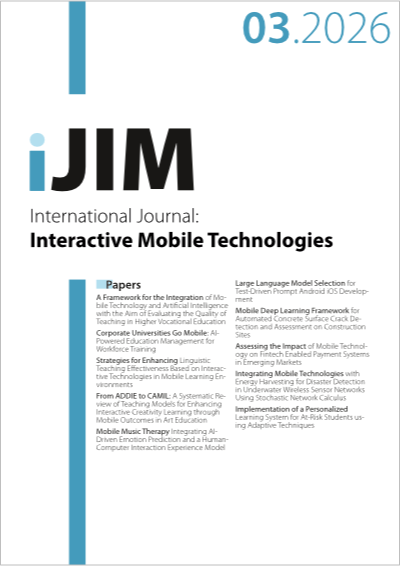
From ADDIE to CAMIL: A Systematic Review of Teaching Models for Enhancing Interactive Creativity Learning through Mobile Outcomes in Art Education
DOI:
https://doi.org/10.3991/ijim.v20i03.60051Keywords:
ADDIE Model, CAMIL, Creativity, Art Education, Instructional Design, Interactive Learning, Experiential LearningAbstract
This study aims to compare and analyze the effectiveness of the analysis-design-developmentimplementation-evaluation (ADDIE) and cognitive-emotional model for immersive learning (CAMIL) instructional design models in promoting the development of learners’ creativity in the field of art education through systematic literature review and meta-synthesis methods. Grounded in social constructivism and experiential learning theory (ELT), the analysis encompasses 25 peer-reviewed studies from Scopus, Web of Science, and ERIC published between 2019 and 2024. The results demonstrate that ADDIE facilitates structured instruction, skill development, and consistent assessment, yet provides limited adaptability for personalized and generative creativity. Conversely, CAMIL more effectively enhances learner autonomy, emotional engagement, and contextualized creative practice through its nonlinear, reflective design, though it requires greater teacher expertise and poses challenges in evaluating complex outcomes. Case studies further substantiate CAMIL’s advantages in fostering emotional and sociocultural creativity. The study recommends integrating the strengths of both models to establish a hybrid instructional approach that balances structure and flexibility in art education.
References
[1] Alam, A., & Mohanty, A. (2023). Implications of virtual reality (VR) for school teachers and instructional designers: An empirical investigation. Cogent Education, 10(2), Article 2260676. https://doi.org/10.1080/2331186X.2023.2260676.
[2] Cheung, L. (2021). Enhancing instructional design for blended learning using ADDIE. Interactive Learning Environments, 29(7), 1062–1076. https://doi.org/10.1080/10494820.2019.1628136
[3] Shahat, H. A., Gaber, S. A., & Aldawsari, H. (2023). Using the ADDIE model to teach creativity in the synthesis of raw materials. International Journal of Learning, Teaching and Educational Research, 22(6). https://doi.org/10.26803/ijlter.22.6.15
[4] Makransky, G., & Petersen, G. B. (2021). The Cognitive Affective Model of Immersive Learning (CAMIL): A theoretical research-based model of learning in immersive virtual reality. Educational Psychology Review, 33(3), 937–958. https://doi.org/10.1007/s10648-020-09586-2
[5] Birsa, E. (2019). Creative realization of art tasks in interdisciplinary learning process. In R. P. Pula (Ed.), Implicit pedagogy for optimized learning in contemporary education (pp. 125–140). IGI Global. https://doi.org/10.4018/978-1-5225-5799-9.CH008
[6] Ali, C. A., Acquah, S., & Esia-Donkoh, K. (2021). A comparative study of SAM and ADDIE models in simulating STEM instruction. African Educational Research Journal, 9(4), 852–859. https://doi.org/10.30918/AERJ.94.21.125
[7] Ali, A. (2020). Critically reflective practice in visual communication design teaching for higher education undergraduate program. International Journal of Technology and Design Education, 32, 1063–1078. https://doi.org/10.1007/s10798-020-09626-6
[8] Tomljenović, Z., & Tatalović Vorkapić, S. (2020). Constructivism in visual arts classes. Center for Educational Policy Studies Journal, 10(2), 67–90. https://doi.org/10.26529/cepsj.913
[9] Spatioti, A. G., Kazanidis, I., & Pange, J. (2022). A comparative study of the ADDIE instructional design model in distance education. Information, 13(9), 402. https://doi.org/10.3390/info13090402
[10] Indriati, L., Mai, N., & Tan, H. (2024). Enhancing authentic assessment in large-class design education through authentic project-based learning. International Journal of Learning, Teaching and Educational Research, 23(9). https://doi.org/10.26803/ijlter.23.9.22
[11] Kolb, A. Y., & Kolb, D. A. (2021). Experiential learning theory: A dynamic, holistic approach to management learning, education and development. Journal of Management Education, 45(3), 393–410. https://doi.org/10.1177/10525629211012482
[12] Nordlund, C. Y., & Hovanec, J. L. (2023). Stepping back to step forward: Reflection in a community of practice. Art Education, 76(1), 8–14. https://doi.org/10.1080/00043125.2023.2167384
[13] Runco, M. A., & Acar, S. (2012). Divergent thinking as an indicator of creative potential. Creativity Research Journal, 24(1), 66–75. https://doi.org/10.1080/10400419.2012.652929.
[14] Almelhi, A. M. (2021). Effectiveness of the ADDIE model within an e-learning environment in developing creative writing in EFL students. English Language Teaching, 14(2), 20–32. https://doi.org/10.5539/elt.v14n2p20
[15] Serrano-Ausejo, E. (2025). Exploring teachers’ views on using immersive virtual reality for teaching history. Digital Education Review, 46, 108–126. https://doi.org/10.1344/der.2025.47.108-126
[16] Zhang, Y., Pi, Z., Chen, L., Zhang, X., & Yang, J. (2021). Online peer assessment improves learners’ creativity: Not only learners’ roles as an assessor or assessee, but also their behavioral sequence matter. Thinking Skills and Creativity, 40, 100950. https://doi.org/10.1016/j.tsc.2021.100950
[17] Neuendorf, K. A. (2021). The content analysis guidebook (2nd ed.). SAGE Publications
[18] Siddaway, A. P., Wood, A. M., & Hedges, L. V. (2019). How to do a systematic review: A best practice guide for conducting and reporting narrative reviews, meta-analyses, and meta-syntheses. Annual Review of Psychology, 70, 747–770. https://doi.org/10.1146/annurev-psych-010418-102803
[19] Mohamed, M., Ab Rashid, S., & Alqaryouti, M. H. (2022). Conceptualizing the complexity of reflective practice in education: A realist synthesis. Frontiers in Psychology, 13, 1008234. https://doi.org/10.3389/fpsyg.2022.1008234
[20] Roessger, K. M. (2020). Assessment strategies for reflective learning in the workplace: A pragmatic approach. Adult Learning, 31(4), 175–184. https://doi.org/10.1177/1045159520941947
[21] Daud, K. A. M., Khidzir, N. Z. B., Hidayat, I. K., & Ismail, M. E. (2024). Empowering art and design education via a flexible curriculum. KnE Social Sciences, 9(15). https://doi.org/10.18502/kss.v9i15.16176
[22] Gu, Y., Chu, R., & Tang, T. (2024). Creativity self-assessments in design education: A systematic review. Thinking Skills and Creativity, 52, 101494. https://doi.org/10.1016/j.tsc.2024.101494
[23] Hokanson, K., Breault, R. R., Lucas, C., Charrois, T., & Schindel, T. J. (2022). Reflective practice: Co-creating reflective activities for pharmacy students. Pharmacy, 10(1), 28. https://doi.org/10.3390/pharmacy10010028
[24] Todd-Adekanye, C. (2017). Visual journaling for (self) education through art education (Master’s thesis, Moore College of Art & Design). ERIC. https://files.eric.ed.gov/fulltext/ED574839.pdf
[25] Harris, D., Coleman, K., & Cook, P. J. (2022). Radical rubrics: Implementing the critical and creative thinking general capability through an ecological approach. The Australian Educational Researcher, 50(3), 729–745. https://doi.org/10.1007/s13384-022-00521-8
[26] Rifdarmon, Ganefri, Remon Lapisa, M. Giatman, Nizwardi Jalinus, & Hasan Maksum. (2024). Integration of Mobile Learning in Rifdarmon Model to Improve Student Learning Outcomes. International Journal of Interactive Mobile Technologies (iJIM), 18(23), pp. 98–109. https://doi.org/10.3991/ijim.v18i23.51217
Downloads
Published
How to Cite
Issue
Section
License
Copyright (c) 2025 Zhao Yan, Jamilah binti Omar

This work is licensed under a Creative Commons Attribution 4.0 International License.


