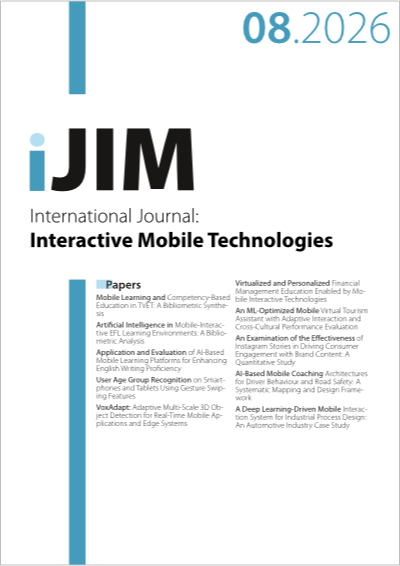
Mobile Learning and Competency-Based Education in TVET: A Bibliometric Synthesis
DOI:
https://doi.org/10.3991/ijim.v20i08.61205Keywords:
quality education, competency-based learning, educational technology, workforce development, learning outcomesAbstract
Mobile learning has emerged as a transformative approach in education, yet a comprehensive synthesis of its application in Technical and Vocational Education and Training (TVET) remains limited. This study maps the research landscape, identifies key themes, evaluates theoretical frameworks, and uncovers research gaps in mobile learning for TVET from 2020 to 2026. A Bibliometric-Systematic Literature Review (B-SLR) was conducted following PRISMA 2020 guidelines using the Scopus database (N = 600 records). Bibliometric analysis employed VOSviewer and the Bibliometrix R package; quality assessment used MMAT 2018. Systematic review of 58 included studies revealed that technology-enhanced pedagogical approaches generally improved learning outcomes in TVET, although effect sizes varied by intervention type and context. VR/AR interventions showed moderate to large effect sizes (d = 0.40–0.84) with some studies reporting null findings, while gamification and LMS-based approaches demonstrated positive but design-dependent results. Nine thematic clusters were identified, with AI and smart technology among the fastest-growing. TAM and UTAUT dominated theoretical frameworks (43.1%), revealing a critical gap in learning-quality-oriented theories. A sub-analysis comparing medical-CBME studies (n = 14) with traditional TVET studies (n = 44) revealed divergent theoretical orientations and assessment challenges. Southeast Asia emerged as the dominant research region, though this concentration warrants caution in generalizing findings. Infrastructure and digital divide constituted the most frequently reported barrier, while psychomotor skills assessment frameworks represented the most TVET-distinctive unaddressed challenge. This study recommends prioritizing longitudinal research, AI integration, the development of psychomotor assessment tools, cross-cultural validation, and cost-effectiveness analysis.
References
N. H. Abd Rahman et al., ‘Governance structures and systemic challenges shaping the future of the technical and vocational education and training (TVET) workforce’, Education + Training, pp. 1–21, Sep. 2025, doi: 10.1108/ET-11-2024-0508.
[2] S. Ngatiman, T. Sulaiman, and K. Y. Wong, ‘The Challenges of Implementing Industrial Revolution 4.0 Elements in TVET’, Journal of Technical Education and Training, vol. 15, no. 3, pp. 169–181, Sep. 2023, Accessed: Feb. 20, 2026. [Online]. Available: https://publisher.uthm.edu.my/ojs/index.php/JTET/article/view/15127
[3] Z. Yu, L. Yu, Q. Xu, W. Xu, and P. Wu, ‘Effects of mobile learning technologies and social media tools on student engagement and learning outcomes of English learning’, Technology, Pedagogy and Education, vol. 31, no. 3, pp. 381–398, May 2022, doi: 10.1080/1475939X.2022.2045215.
[4] N. A. A. Abdelwahed and B. A. Soomro, ‘Attitudes and intentions towards the adoption of mobile learning during COVID-19: building an exciting career through vocational education’, Education + Training, vol. 65, no. 2, pp. 210–231, Jun. 2022, doi: 10.1108/ET-02-2022-0048.
[5] W. C. Lee and B. C. Y. Tan, ‘Workplace learning strategies, enablers, and challenges in the context of digital innovation’, Journal of Workplace Learning, vol. 35, no. 2, pp. 192–209, Feb. 2023, doi: 10.1108/JWL-04-2022-0045.
[6] H. Crompton and D. Burke, ‘The use of mobile learning in higher education: A systematic review’, Computers & Education, vol. 123, pp. 53–64, Aug. 2018, doi: 10.1016/j.compedu.2018.04.007.
[7] A. D. Samala, S. Papadakis, and S. Rawas, ‘Global Insights into Mobile Learning in Higher Education: A PRISMA-Guided Bibliometric Analysis from 2007 to 2023’, International Journal of Educational Reform, p. 10567879251341869, May 2025, doi: 10.1177/10567879251341869.
[8] R. H. Hassan, M. T. Hassan, S. Naseer, Z. Khan, and M. Jeon, ‘ICT Enabled TVET Education: A Systematic Literature Review’, IEEE Access, vol. 9, pp. 81624–81650, 2021, doi: 10.1109/ACCESS.2021.3085910.
[9] S. Papadakis, S. H. Lytvynova, S. M. Ivanova, and I. A. Selyshcheva, ‘Advancing lifelong learning with AI-enhanced ICT: A review of 3L-Person 2024’, CEUR Workshop Proceedings, 2024. [Online]. Available: https://elibrary.kdpu.edu.ua/handle/123456789/10942
[10] J. Guo, F. Huang, Y. Lou, and S. Chen, ‘Students perceptions of using mobile technologies in informal English learning during the COVID-19 epidemic: A study in Chinese rural secondary schools’, JPR, vol. 4, no. 4, pp. 475–483, Oct. 2020, doi: 10.33902/JPR.2020063786.
[11] G. Marzi, M. Balzano, A. Caputo, and M. M. Pellegrini, ‘Guidelines for Bibliometric-Systematic Literature Reviews: 10 steps to combine analysis, synthesis and theory development’, International Journal of Management Reviews, vol. 27, no. 1, pp. 81–103, 2025, doi: 10.1111/ijmr.12381.
[12] T. Karakose, T. Tülübaş, S. Papadakis, and R. Yirci, ‘Evaluating the Intellectual Structure of the Knowledge Base on Transformational School Leadership: A Bibliometric and Science Mapping Analysis’, Education Sciences, vol. 13, no. 7, p. 708, Jul. 2023, doi: 10.3390/educsci13070708.
[13] M. J. Page et al., ‘The PRISMA 2020 statement: an updated guideline for reporting systematic reviews’, BMJ, vol. 372, p. n71, Mar. 2021, doi: 10.1136/bmj.n71.
[14] L. Pedraja-Rejas, C. Muñoz-Fritis, E. Rodríguez-Ponce, and D. Laroze, ‘Mobile Learning and Its Effect on Learning Outcomes and Critical Thinking: A Systematic Review’, Applied Sciences, vol. 14, no. 19, p. 9105, Jan. 2024, doi: 10.3390/app14199105.
[15] Q. N. Hong et al., ‘The Mixed Methods Appraisal Tool (MMAT) version 2018 for information professionals and researchers’, Education for Information, vol. 34, no. 4, pp. 285–291, Nov. 2018, doi: 10.3233/EFI-180221.
[16] N. van Eck and L. Waltman, ‘Software survey: VOSviewer, a computer program for bibliometric mapping’, Scientometrics, vol. 84, no. 2, pp. 523–538, Dec. 2009, doi: 10.1007/s11192-009-0146-3.
[17] M. Aria and C. Cuccurullo, ‘bibliometrix: An R-tool for comprehensive science mapping analysis’, Journal of Informetrics, vol. 11, no. 4, pp. 959–975, Nov. 2017, doi: 10.1016/j.joi.2017.08.007.
[18] V. Braun and V. Clarke, ‘Using thematic analysis in psychology’, Qualitative Research in Psychology, vol. 3, no. 2, pp. 77–101, Jan. 2006, doi: 10.1191/1478088706qp063oa.
[19] M. Z. Abd Majid, S. Kasavan, and R. Siron, ‘Bibliometric analysis and science mapping of global scientific publications on technical vocational education training (TVET)’, Library Hi Tech, vol. 42, no. 1, pp. 8–32, Aug. 2022, doi: 10.1108/LHT-12-2021-0485.
[20] W. Wagino, H. Maksum, W. Purwanto, K. Krismadinata, S. Suhendar, and R. D. Koto, ‘Exploring the Full Potential of Collaborative Learning and E-Learning Environments in Universities: A Systematic Review’, TEM Journal, pp. 1772–1785, Aug. 2023, doi: 10.18421/TEM123-60.
[21] W. Wagino, H. Maksum, W. Purwanto, W. Simatupang, R. Lapisa, and E. Indrawan, ‘Enhancing Learning Outcomes and Student Engagement: Integrating E-Learning Innovations into Problem-Based Higher Education’, Int. J. Interact. Mob. Technol., vol. 18, no. 10, pp. 106–124, May 2024, doi: 10.3991/ijim.v18i10.47649.
[22] H. Maksum, W. Wagino, W. Purwanto, M. Muslim, R. Putra, and R. D. Koto, ‘Quantifying the Impact of Problem-Based Learning Enhanced by E-Learning: An Advanced Statistical and Effect Size Approach in Vocational Studies’, TEM Journal, pp. 2744–2754, Aug. 2025, doi: 10.18421/TEM143-75.
[23] W. Wagino, ‘Assessing Student Expectations, Perceived Quality, Value, and Satisfaction through PBL and Elearning Integration in Vocational Education’, JEO, vol. 22, no. 4, Sep. 2025, doi: 10.9743/JEO.2025.22.4.15.
[24] F. Dahalan, N. Alias, and M. S. N. Shaharom, ‘Gamification and Game Based Learning for Vocational Education and Training: A Systematic Literature Review’, Educ Inf Technol, vol. 29, no. 2, pp. 1279–1317, Feb. 2024, doi: 10.1007/s10639-022-11548-w.
[25] F.-K. Chiang, X. Shang, and L. Qiao, ‘Augmented reality in vocational training: A systematic review of research and applications’, Computers in Human Behavior, vol. 129, p. 107125, Apr. 2022, doi: 10.1016/j.chb.2021.107125.
[26] K. Syauqi, S. Munadi, and M. B. Triyono, ‘Students’ perceptions toward vocational education on online learning during the COVID-19 pandemic’, IJERE, vol. 9, no. 4, p. 881, Dec. 2020, doi: 10.11591/ijere.v9i4.20766.
[27] J. Jayalath and V. Esichaikul, ‘Gamification to Enhance Motivation and Engagement in Blended eLearning for Technical and Vocational Education and Training’, Tech Know Learn, vol. 27, no. 1, pp. 91–118, Mar. 2022, doi: 10.1007/s10758-020-09466-2.
[28] M. Portelli, S. Bianco, T. Bezzina, and J. Abela, ‘Virtual reality training compared with apprenticeship training in laparoscopic surgery: a meta-analysis’, annals, vol. 102, no. 9, pp. 672–684, Nov. 2020, doi: 10.1308/rcsann.2020.0178.
[29] T. Sangsawang, ‘An Instructional Design for Online Learning in Vocational Education according to a Self-Regulated Learning Framework for Problem Solving during the CoViD-19 Crisis’, Indonesian Journal of Science and Technology, vol. 5, no. 2, pp. 283–298, Sep. 2020, doi: 10.17509/ijost.v5i2.24702.
[30] R. Rabiman, M. Nurtanto, and N. Kholifah, ‘Design And Development E-Learning System By Learning Management System (LMS) In Vocational Education’, vol. 9, no. 01, 2020, [Online]. Available: https://www.ijstr.org/final-print/jan2020/Design-And-Development-E-learning-System-By-Learning-Management-System-lms-In-Vocational-Education.pdf
[31] B. Zheng, A. Ward, and R. Stanulis, ‘Self-regulated learning in a competency-based and flipped learning environment: learning strategies across achievement levels and years’, Medical Education Online, vol. 25, no. 1, p. 1686949, Jan. 2020, doi: 10.1080/10872981.2019.1686949.
[32] O. O. Lavrentieva, I. O. Arkhypov, O. I. Kuchma, and A. D. Uchitel, ‘Use of simulators together with virtual and augmented reality in the system of welders’ vocational training: past, present, and future’, Augmented Reality in Education : Proceedings of the 2nd International Workshop (AREdu 2019), Kryvyi Rih, Ukraine, March 22, 2019, no. 2547, pp. 201–216, 2020, Accessed: Feb. 20, 2026. [Online]. Available: http://ceur-ws.org/Vol-2547/paper15.pdf
[33] C. Antonietti, A. Cattaneo, and F. Amenduni, ‘Can teachers’ digital competence influence technology acceptance in vocational education?’, Computers in Human Behavior, vol. 132, p. 107266, Jul. 2022, doi: 10.1016/j.chb.2022.107266.
[34] A. A. P. Cattaneo, C. Antonietti, and M. Rauseo, ‘How digitalised are vocational teachers? Assessing digital competence in vocational education and looking at its underlying factors’, Computers & Education, vol. 176, p. 104358, Jan. 2022, doi: 10.1016/j.compedu.2021.104358.
[35] P. Beer and R. H. Mulder, ‘The Effects of Technological Developments on Work and Their Implications for Continuous Vocational Education and Training: A Systematic Review’, Front. Psychol., vol. 11, May 2020, doi: 10.3389/fpsyg.2020.00918.
[36] W. K. George, E. I. Silas, D. Pandey, and B. K. Pandey, ‘Utilization of Industry 4.0 Technologies in Nigerian Technical and Vocational Education: A Conundrum for Educators’, in Examining the Rapid Advance of Digital Technology in Africa, IGI Global Scientific Publishing, 2024, pp. 272–295. doi: 10.4018/978-1-6684-9962-7.ch014.
[37] S. Chatterjee, K. K. Bhattacharjee, C.-W. Tsai, and A. K. Agrawal, ‘Impact of peer influence and government support for successful adoption of technology for vocational education: A quantitative study using PLS-SEM technique’, Qual Quant, vol. 55, no. 6, pp. 2041–2064, Dec. 2021, doi: 10.1007/s11135-021-01100-2.
[38] J.-H. Ye, Y.-T. Wu, Y.-F. Wu, M.-Y. Chen, and J.-N. Ye, ‘Effects of Short Video Addiction on the Motivation and Well-Being of Chinese Vocational College Students’, Front. Public Health, vol. 10, May 2022, doi: 10.3389/fpubh.2022.847672.
[39] J. Radianti, T. A. Majchrzak, J. Fromm, and I. Wohlgenannt, ‘A systematic review of immersive virtual reality applications for higher education: Design elements, lessons learned, and research agenda’, Computers & Education, vol. 147, p. 103778, Apr. 2020, doi: 10.1016/j.compedu.2019.103778.
[40] R. E. Baticulon et al., ‘Barriers to Online Learning in the Time of COVID-19: A National Survey of Medical Students in the Philippines’, Med.Sci.Educ., vol. 31, no. 2, pp. 615–626, Apr. 2021, doi: 10.1007/s40670-021-01231-z.
[41] R. Q. Mao et al., ‘Immersive Virtual Reality for Surgical Training: A Systematic Review’, Journal of Surgical Research, vol. 268, pp. 40–58, Dec. 2021, doi: 10.1016/j.jss.2021.06.045.
[42] H. A. Alamri, S. Watson, and W. Watson, ‘Learning Technology Models that Support Personalization within Blended Learning Environments in Higher Education’, TechTrends, vol. 65, no. 1, pp. 62–78, Jan. 2021, doi: 10.1007/s11528-020-00530-3.
[43] K. Leong, A. Sung, D. Au, and C. Blanchard, ‘A review of the trend of microlearning’, Journal of Work-Applied Management, vol. 13, no. 1, pp. 88–102, Dec. 2020, doi: 10.1108/JWAM-10-2020-0044.
[44] R. De Ponti, J. Marazzato, A. M. Maresca, F. Rovera, G. Carcano, and M. M. Ferrario, ‘Pre-graduation medical training including virtual reality during COVID-19 pandemic: a report on students’ perception’, BMC Med Educ, vol. 20, no. 1, p. 332, Sep. 2020, doi: 10.1186/s12909-020-02245-8.
[45] H. El-Sofany and N. El-Haggar, The Effectiveness of Using Mobile Learning Techniques to Improve Learning Outcomes in Higher Education. International Association of Online Engineering, 2020, pp. 4–18. Accessed: Feb. 20, 2026. [Online]. Available: https://www.learntechlib.org/p/216981/
[46] S. Pedram, S. Palmisano, R. Skarbez, P. Perez, and M. Farrelly, ‘Investigating the process of mine rescuers’ safety training with immersive virtual reality: A structural equation modelling approach’, Computers & Education, vol. 153, p. 103891, Aug. 2020, doi: 10.1016/j.compedu.2020.103891.
[47] M. Silic and P. B. Lowry, ‘Using Design-Science Based Gamification to Improve Organizational Security Training and Compliance’, Journal of Management Information Systems, vol. 37, no. 1, pp. 129–161, Jan. 2020, doi: 10.1080/07421222.2019.1705512.
[48] B. Zheng and Y. Zhang, ‘Self-regulated learning: the effect on medical student learning outcomes in a flipped classroom environment’, BMC Med Educ, vol. 20, no. 1, p. 100, Mar. 2020, doi: 10.1186/s12909-020-02023-6.
[49] S. D. A. Bujang, A. Selamat, O. Krejcar, P. Maresova, and N. T. Nguyen, ‘Digital Learning Demand for Future Education 4.0—Case Studies at Malaysia Education Institutions’, Informatics, vol. 7, no. 2, p. 13, Jun. 2020, doi: 10.3390/informatics7020013.
[50] S. B. Dias, S. J. Hadjileontiadou, J. Diniz, and L. J. Hadjileontiadis, ‘DeepLMS: a deep learning predictive model for supporting online learning in the Covid-19 era’, Sci Rep, vol. 10, no. 1, p. 19888, Nov. 2020, doi: 10.1038/s41598-020-76740-9.
[51] N. T. T. Ho, S. Sivapalan, H. H. Pham, L. T. M. Nguyen, A. T. V. Pham, and H. V. Dinh, ‘Students’ adoption of e-learning in emergency situation: the case of a Vietnamese university during COVID-19’, Interactive Technology and Smart Education, vol. 18, no. 2, pp. 246–269, Dec. 2020, doi: 10.1108/ITSE-08-2020-0164.
[52] P. Egielewa, P. O. Idogho, F. O. Iyalomhe, and G. T. Cirella, ‘COVID-19 and digitized education: Analysis of online learning in Nigerian higher education’, E-Learning and Digital Media, vol. 19, no. 1, pp. 19–35, Jan. 2022, doi: 10.1177/20427530211022808.
[53] K. A. Bird, B. L. Castleman, and G. Lohner, ‘Negative Impacts From the Shift to Online Learning During the COVID-19 Crisis: Evidence From a Statewide Community College System’, AERA Open, vol. 8, p. 23328584221081220, Jan. 2022, doi: 10.1177/23328584221081220.
[54] S. Venkatesh, Y. K. Rao, H. Nagaraja, T. Woolley, F. O. Alele, and B. S. Malau-Aduli, ‘Factors Influencing Medical Students’ Experiences and Satisfaction with Blended Integrated E-Learning’, Med Princ Pract, vol. 29, no. 4, pp. 396–402, Dec. 2019, doi: 10.1159/000505210.
[55] J. Zhang and R. E. West, ‘Designing Microlearning Instruction for ProfessionalDevelopment Through a Competency Based Approach’, TechTrends, vol. 64, no. 2, pp. 310–318, Mar. 2020, doi: 10.1007/s11528-019-00449-4.
[56] S. Abbasi, T. Ayoob, A. Malik, and S. I. Memon, ‘Perceptions of students regarding E-learning during Covid-19 at a private medical college’, Pakistan Journal of Medical Sciences, vol. 36, no. COVID19-S4, p. S57, May 2020, doi: 10.12669/pjms.36.COVID19-S4.2766.
[57] D. Lerner, S. Mohr, J. Schild, M. Göring, and T. Luiz, ‘An Immersive Multi-User Virtual Reality for Emergency Simulation Training: Usability Study’, JMIR Serious Games, vol. 8, no. 3, p. e18822, Jul. 2020, doi: 10.2196/18822.
[58] V. G. Goulart, L. B. Liboni, and L. O. Cezarino, ‘Balancing skills in the digital transformation era: The future of jobs and the role of higher education - Vera G. Goulart, Lara Bartocci Liboni, Luciana Oranges Cezarino, 2022’, Sage Journals, Jul. 2021, doi: 10.1177/09504222211029796.
[59] F. Mutohhari, S. Sutiman, M. Nurtanto, N. Kholifah, and A. Samsudin, ‘Difficulties in implementing 21st century skills competence in vocational education learning’, IJERE, vol. 10, no. 4, p. 1229, Dec. 2021, doi: 10.11591/ijere.v10i4.22028.
[60] S. M. Indrawati and A. Kuncoro, ‘Improving Competitiveness Through Vocational and Higher Education: Indonesia’s Vision For Human Capital Development In 2019–2024’, Bulletin of Indonesian Economic Studies, vol. 57, no. 1, pp. 29–59, Jan. 2021, doi: 10.1080/00074918.2021.1909692.
[61] A. Ana, ‘Trends in Expert System Development: A Practicum Content Analysis in Vocational Education for Over Grow Pandemic Learning Problems’, Indonesian Journal of Science and Technology, vol. 5, no. 2, pp. 246–260, Sep. 2020, doi: 10.17509/ijost.v5i2.24616.
[62] S. McGrath et al., ‘Vocational education and training for African development: a literature review’, Journal of Vocational Education & Training, vol. 72, no. 4, pp. 465–487, Oct. 2020, doi: 10.1080/13636820.2019.1679969.
[63] J. Li and M. Pilz, ‘International transfer of vocational education and training: a literature review’, Journal of Vocational Education & Training, vol. 75, no. 2, pp. 185–218, Mar. 2023, doi: 10.1080/13636820.2020.1847566.
[64] S. McGrath and S. Yamada, ‘Skills for development and vocational education and training: Current and emergent trends’, International Journal of Educational Development, vol. 102, p. 102853, Oct. 2023, doi: 10.1016/j.ijedudev.2023.102853.
[65] A. K. Hall et al., ‘Training disrupted: Practical tips for supporting competency-based medical education during the COVID-19 pandemic’, Medical Teacher, vol. 42, no. 7, pp. 756–761, Jul. 2020, doi: 10.1080/0142159X.2020.1766669.
[66] A. K. Hall et al., ‘It’s a Marathon, Not a Sprint: Rapid Evaluation of Competency-Based Medical Education Program Implementation’, Acad Med, vol. 95, no. 5, pp. 786–793, May 2020, doi: 10.1097/ACM.0000000000003040.
[67] L. Branfield Day, A. Miles, S. Ginsburg, and L. Melvin, ‘Resident Perceptions of Assessment and Feedback in Competency-Based Medical Education: A Focus Group Study of One Internal Medicine Residency Program’, Acad Med, vol. 95, no. 11, pp. 1712–1717, Nov. 2020, doi: 10.1097/ACM.0000000000003315.
[68] D. Richardson et al., ‘Growth mindset in competency-based medical education’, Medical Teacher, vol. 43, no. 7, pp. 751–757, Jul. 2021, doi: 10.1080/0142159X.2021.1928036.
[69] V. R. Downing, K. M. Cooper, J. M. Cala, L. E. Gin, and S. E. Brownell, ‘Fear of Negative Evaluation and Student Anxiety in Community College Active-Learning Science Courses’, LSE, vol. 19, no. 2, p. ar20, Jun. 2020, doi: 10.1187/cbe.19-09-0186.
[70] L. S. Lewis, L. M. Rebeschi, and E. Hunt, ‘Nursing Education Practice Update 2022: Competency-Based Education in Nursing’, Sage Open Nursing, vol. 8, p. 23779608221140774, Jan. 2022, doi: 10.1177/23779608221140774.
[71] A. H. Stevens, M. Kurlaender, and M. Grosz, ‘Career Technical Education and Labor Market Outcomes: Evidence from California Community Colleges’, Journal of Human Resources, vol. 54, no. 4, pp. 986–1036, Oct. 2019, doi: 10.3368/jhr.54.4.1015.7449R2.
[72] Y. Ling, S. J. Chung, and L. Wang, ‘Research on the reform of management system of higher vocational education in China based on personality standard’, Curr Psychol, vol. 42, no. 2, pp. 1225–1237, Jan. 2023, doi: 10.1007/s12144-021-01480-6.
[73] S. S. Gill et al., ‘Transformative effects of ChatGPT on modern education: Emerging Era of AI Chatbots’, Internet of Things and Cyber-Physical Systems, vol. 4, pp. 19–23, Jan. 2024, doi: 10.1016/j.iotcps.2023.06.002.
[74] N. J. Francis, S. Jones, and D. P. Smith, ‘Generative AI in Higher Education: Balancing Innovation and Integrity’, Br. J. Biomed. Sci., vol. 81, p. 14048, Jan. 2025, doi: 10.3389/bjbs.2024.14048.
[75] E. E. S. Wiguna et al., ‘Raspberry Pi-Based Offline Digital Library for Indonesian Villages Without Stable Power and Internet Access: A Case Study on Implementing Raspberry Pi-Based Offline Digital Library in Indonesia’, Information Technology and Libraries, vol. 43, no. 4, Dec. 2024, doi: 10.5860/ital.v43i4.16869.
[76] C.-H. Li, ‘Enhancing Vocational Certification Learning through a Gamified Chatbot: Evidence from a Quasi-Experimental Study’, Advances in Mobile Learning Educational Research, vol. 6, no. 1, pp. 1653–1667, 2026, doi: 10.25082/AMLER.2026.01.001.
[77] A. T. Baharin, N. A. Sahadun, S. Ramli, and N. A. liyana Redzuan, ‘Exploring the Adoption of Generative Artificial Intelligence by TVET Students: A UTAUT Analysis of Perceptions, Benefits, and Implementation Challenges’, jisem, vol. 10, no. 19s, pp. 429–437, Mar. 2025, doi: 10.52783/jisem.v10i19s.3052.
[78] L. Xue, A. M. Rashid, and S. Ouyang, ‘The Unified Theory of Acceptance and Use of Technology (UTAUT) in Higher Education: A Systematic Review’, Sage Open, vol. 14, no. 1, p. 21582440241229570, Jan. 2024, doi: 10.1177/21582440241229570.
[79] M. Muktiarni, I. Widiaty, L. Widaningsih, C. Yulia, N. I. Rahayu, and N. A. Ismail, ‘Technology Integration and Ocean Literacy in Vocational Tourism Education: A Study in the Context of the Sustainable Development Goals (SDGs)’, Indonesian Journal of Science and Technology, vol. 11, no. 3, pp. 369–390, 2026, doi: 10.17509/ijost.v11i3.89816.
[80] N. Tunjera and A. Chigona, ‘Assisting teacher educators with constructive technology integration into curriculum delivery in the 21st Century’, in Conference of the South African Institute of Computer Scientists and Information Technologists 2020, in SAICSIT ’20. New York, NY, USA: Association for Computing Machinery, Sep. 2020, pp. 12–18. doi: 10.1145/3410886.3410900.
[81] K. Cáceres-Nakiche, W. Carcausto-Calla, S. R. Yabar Arrieta, and R. M. Lino Tupiño, ‘The SAMR Model in Education Classrooms: Effects on Teaching Practice, Facilities, and Challenges’, JHETP, vol. 24, no. 2, Feb. 2024, doi: 10.33423/jhetp.v24i2.6816.
[82] X. Chen and S. Chan, ‘Implementing digital pedagogy in TVET: A Connectivist perspective’, Vocation, Technology & Education, vol. 1, no. 2, Jun. 2024, doi: 10.54844/vte.2024.0595.
[83] S. Criollo-C, A. Guerrero-Arias, Á. Jaramillo-Alcázar, and S. Luján-Mora, ‘Mobile Learning Technologies for Education: Benefits and Pending Issues’, Applied Sciences, vol. 11, no. 9, p. 4111, Jan. 2021, doi: 10.3390/app11094111.
[84] A. M. Maatuk, E. K. Elberkawi, S. Aljawarneh, H. Rashaideh, and H. Alharbi, ‘The COVID-19 pandemic and E-learning: challenges and opportunities from the perspective of students and instructors’, J Comput High Educ, vol. 34, no. 1, pp. 21–38, Apr. 2022, doi: 10.1007/s12528-021-09274-2.
[85] M. Imanipour, A. Ebadi, H. Monadi Ziarat, and M. M. Mohammadi, ‘The effect of competency-based education on clinical performance of health care providers: A systematic review and meta-analysis’, International Journal of Nursing Practice, vol. 28, no. 1, p. e13003, 2022, doi: 10.1111/ijn.13003.
[86] R. Bödding, S. A. Schriek, and G. W. Maier, ‘A systematic review and meta-analysis of mixed reality in vocational education and training: examining behavioral, cognitive, and affective training outcomes and possible moderators’, Virtual Reality, vol. 29, no. 1, p. 44, Feb. 2025, doi: 10.1007/s10055-025-01118-z.
[87] Q. N. Naveed, H. Choudhary, N. Ahmad, J. Alqahtani, and A. I. Qahmash, ‘Mobile Learning in Higher Education: A Systematic Literature Review’, Sustainability, vol. 15, no. 18, p. 13566, Jan. 2023, doi: 10.3390/su151813566.
[88] D. Kablitz, M. Conrad, and S. Schumann, ‘Immersive VR-based instruction in vocational schools: effects on domain-specific knowledge and wellbeing of retail trainees’, Empirical Res Voc Ed Train, vol. 15, no. 1, p. 9, Sep. 2023, doi: 10.1186/s40461-023-00148-8.
[89] K. G. Kim et al., ‘Using immersive virtual reality to support designing skills in vocational education’, British Journal of Educational Technology, vol. 51, no. 6, pp. 2199–2213, 2020, doi: 10.1111/bjet.13026.
[90] C. Weng, K. N. P. Tran, C.-C. Yang, H.-I. Huang, and H. Chen, ‘Can an augmented reality-integrated gamification approach enhance vocational high school students’ learning outcomes and motivation in an electronics course?’, Educ Inf Technol, vol. 29, no. 4, pp. 4025–4053, Mar. 2024, doi: 10.1007/s10639-023-11966-4.
[91] M. M. Hosseini et al., ‘Unleashing the potential of education: embracing a new era of learning through feedback evolution’, Discov Educ, vol. 5, no. 1, p. 121, Jan. 2026, doi: 10.1007/s44217-026-01110-y.
[92] L. Tan, T. Ratanaolarn, and K. Sriwisathiyakun, ‘Project-based blended learning for vocational education: Enhancing digital marketing competencies and team spirit’, Cogent Education, vol. 12, no. 1, p. 2498092, Dec. 2025, doi: 10.1080/2331186X.2025.2498092.
[93] Y. Liu and A. Pásztor, ‘Effects of problem-based learning instructional intervention on critical thinking in higher education: A meta-analysis’, Thinking Skills and Creativity, vol. 45, p. 101069, Sep. 2022, doi: 10.1016/j.tsc.2022.101069.
[94] X. Zhou, ‘A conceptual review of the effectiveness of flipped learning in vocational learners’ cognitive skills and emotional states’, Front. Psychol., vol. 13, Jan. 2023, doi: 10.3389/fpsyg.2022.1039025.
[95] M. Govender, Experiences of LMS adoption under COVID-19 by a software company’s client training and support staff. University of Johannesburg (South Africa), 2022.
[96] N. Donthu, S. Kumar, D. Mukherjee, N. Pandey, and W. M. Lim, ‘How to conduct a bibliometric analysis: An overview and guidelines’, Journal of Business Research, vol. 133, pp. 285–296, Sep. 2021, doi: 10.1016/j.jbusres.2021.04.070.
[97] G. Kaisara and K. J. Bwalya, ‘Mobile Learning in Higher Education: Insights from a Bibliometric Analysis of the Body of Knowledge’, International Journal of Learning, Teaching and Educational Research, vol. 22, no. 6, pp. 152–174, Jun. 2023, doi: 10.26803/ijlter.22.6.9.
[98] A. Valencia-Arias, S. Cardona-Acevedo, S. Gómez-Molina, R. M. V. Holguín, and J. Valencia, ‘Adoption of mobile learning in the university context: Systematic literature review’, PLOS ONE, vol. 19, no. 6, p. e0304116, Jun. 2024, doi: 10.1371/journal.pone.0304116.
[99] S.-F. Fam, X.-E. Lan, S. I. Wahjono, and M. K. Sahlan, ‘Bibliometric Analysis on Technical and Vocational Education and Training (TVET) Research’, IJARPED, vol. 13, no. 3, p. Pages 2528-2547, Aug. 2024, doi: 10.6007/IJARPED/v13-i3/22260.
[100] S. W. Chong, T. J. Lin, and Y. Chen, ‘A methodological review of systematic literature reviews in higher education: Heterogeneity and homogeneity’, Educational Research Review, vol. 35, p. 100426, Feb. 2022, doi: 10.1016/j.edurev.2021.100426.
[101] M. Bond et al., ‘A meta systematic review of artificial intelligence in higher education: a call for increased ethics, collaboration, and rigour’, Int J Educ Technol High Educ, vol. 21, no. 1, p. 4, Jan. 2024, doi: 10.1186/s41239-023-00436-z.
[102] M. Sailer, R. Maier, S. Berger, T. Kastorff, and K. Stegmann, ‘Learning activities in technology-enhanced learning: A systematic review of meta-analyses and second-order meta-analysis in higher education’, Learning and Individual Differences, vol. 112, p. 102446, May 2024, doi: 10.1016/j.lindif.2024.102446.
Downloads
Published
How to Cite
Issue
Section
License
Copyright (c) 2026 Wagino Wagino, Volodymyr Tymofiiv, Ken Polin, Nuzul Hidayat, Muslim Muslim, Rahmat Desman Koto

This work is licensed under a Creative Commons Attribution 4.0 International License.