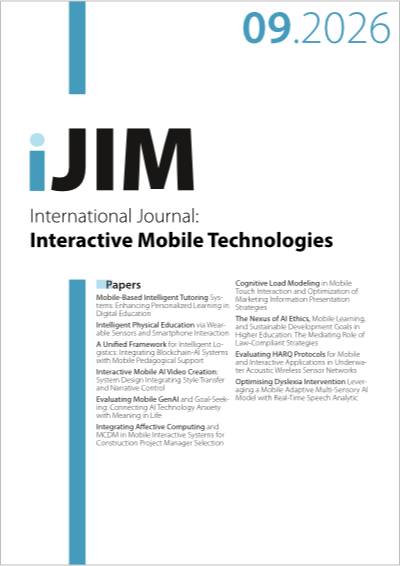
Integrating Affective Computing and MCDM in Mobile Interactive Systems for Construction Project Manager Selection
DOI:
https://doi.org/10.3991/ijim.v20i09.61575Keywords:
Affective Computing, Multi-Criteria Decision-Making (MCDM), Emotional Intelligence (EI), Convolutional Neural Network (CNN), Construction Project Manager SelectionAbstract
Selecting an effective construction project manager is critical to project success, given the complex, high-risk, and people-intensive nature of construction environments. While existing selection frameworks emphasize technical expertise and managerial experience, behavioral and emotional factors that influence leadership and team performance are often assessed subjectively or overlooked. Moreover, conventional multi-criteria decision-making (MCDM) approaches remain largely static and are not designed to capture emotion-related dynamics during evaluation. To address these limitations, this study proposes an integrated framework that combines a mobile interactive system for affective computing with MCDM techniques for construction project manager selection. Facial expressions elicited during structured interview scenarios are analyzed using deep learning–based emotion recognition, incorporating both categorical emotions and pleasure–arousal–dominance (PAD)–based intensity measures to quantify emotional intelligence objectively. These affective indicators are then integrated with technical, managerial, and communication criteria within an MCDM framework to generate systematic and transparent candidate rankings. The proposed approach advances existing selection methods by operationalizing emotional intelligence as a measurable decision attribute and embedding it within a structured decision-support system. By enabling the joint evaluation of cognitive and affective competencies through a platform-independent framework, this study offers a more holistic, consistent, and context-aware basis for construction project manager selection, with practical implications for improving managerial effectiveness and project outcomes.
References
[1] U. Elraaid, I. Badi, and M. B. Bouraima, “Identifying and Addressing Obstacles to Project Management Office Success in Construction Projects: An AHP Approach,” Spectrum of Decision Making and Applications, vol. 1, no. 1, pp. 33–45, Jul. 2024, doi: 10.31181/sdmap1120242.
[2] F. Torfi and A. Rashidi, “Selection of Project Managers in Construction Firms Using Analytic Hierarchy Process (AHP) and Fuzzy Topsis: A Case Study,” 2011.
[3] T. Avramova, T. Peneva, and A. Ivanov, “Overview of Existing Multi-Criteria Decision-Making (MCDM) Methods Used in Industrial Environments,” Oct. 01, 2025, Multidisciplinary Digital Publishing Institute (MDPI). doi: 10.3390/technologies13100444.
[4] M. A. M. Fateh, A. N. Supian, and C. S. Goh, “Managing Emotional Intelligence of Construction Players During COVID-19 in Malaysia,” Journal of Construction in Developing Countries, vol. 29, no. 1, pp. 191–210, 2024, doi: 10.21315/jcdc-04-23-0036.
[5] M. A. Mansor, “Multi-Criteria Decision Making for Prioritizing Project Manager Skills according to Construction Project Success Factors,” Engineering, Technology and Applied Science Research, vol. 15, no. 2, pp. 21861–21875, Apr. 2025, doi: 10.48084/etasr.10083.
[6] M. N. M. Nawi, M. F. Omar, R. A. Odeh, A. G. Hanafi, F. A. A. Nifa, and M. K. I. A. Rahim, “A Conceptual Approach of an Integrated Multi Criteria Decision Making Techniques and Deep Learning for Construction Project Managers Selection Problem,” International Journal of Interactive Mobile Technologies, vol. 18, no. 13, pp. 166–178, Jul. 2024, doi: 10.3991/ijim.v18i13.49119.
[7] L. F. da Silva, P. S. Gonçalves De Oliveira, G. Grander, R. Penha, and F. S. Bizarrias, “Soft skills fuzzy TOPSIS ranked multi-criteria to select project manager,” International Journal of Information and Decision Sciences, vol. 16, no. 1, pp. 19–45, 2024, doi: 10.1504/ijids.2024.10061740.
[8] S. Moradi, K. Kähkönen, and K. Aaltonen, “Comparison of research and industry views on project managers’ competencies,” May 29, 2020, Emerald Group Holdings Ltd. doi: 10.1108/IJMPB-04-2019-0085.
[9] R. Kassa, I. Ogundare, B. Lines, J. B. Smithwick, N. J. Kepple, and K. T. Sullivan, “Developing a construct to measure contractor project manager performance competencies,” Engineering, Construction and Architectural Management, vol. 32, no. 3, pp. 2003–2021, Nov. 2023, doi: 10.1108/ECAM-12-2022-1122.
[10] K. Szczepańska-Woszczyna and S. Gatnar, “Key competences of research and development project managers in high technology sector,” Forum Scientiae Oeconomia, vol. 10, no. 3, pp. 107–130, 2022, doi: 10.23762/FSO_VOL10_NO3_6.
[11] A. Mehrabian, “Pleasure-Arousal.Dominance: A General Framework for Describing and Measuring Individual Differences in Temperament,” 1996.
[12] K. Schlegel and M. Mortillaro, “The Geneva Emotional Competence Test (GECo): An Ability Measure of Workplace Emotional Intelligence,” Journal of Applied Psychology, vol. 104, pp. 559–580, Oct. 2018, doi: 10.1037/apl0000365.
[13] J. Hu, L. Mathur, P. P. Liang, and L.-P. Morency, “OpenFace 3.0: A Lightweight Multitask System for Comprehensive Facial Behavior Analysis,” Jun. 2025, [Online]. Available: http://arxiv.org/abs/2506.02891
[14] P. Weinzaepfel, J. Revaud, Z. Harchaoui, and C. Schmid, “DeepFlow: Large displacement optical flow with deep matching,” in Proceedings of the IEEE International Conference on Computer Vision, Institute of Electrical and Electronics Engineers Inc., 2013, pp. 1385–1392. doi: 10.1109/ICCV.2013.175.
[15] C.-L. Hwang and K. Yoon, “Methods for Multiple Attribute Decision Making,” in Multiple Attribute Decision Making: Methods and Applications A State-of-the-Art Survey, C.-L. Hwang and K. Yoon, Eds., Berlin, Heidelberg: Springer Berlin Heidelberg, 1981, pp. 58–191. doi: 10.1007/978-3-642-48318-9_3.
[16] S. Opricovic and G. H. Tzeng, “Compromise solution by MCDM methods: A comparative analysis of VIKOR and TOPSIS,” Eur. J. Oper. Res., vol. 156, no. 2, pp. 445–455, Jul. 2004, doi: 10.1016/S0377-2217(03)00020-1.
Downloads
Published
How to Cite
Issue
Section
License
Copyright (c) 2026 Nurul Hafizah Hazwani Hashim, Mohd Nasrun Mohd Nawi, Mohd Faizal Omar

This work is licensed under a Creative Commons Attribution 4.0 International License.