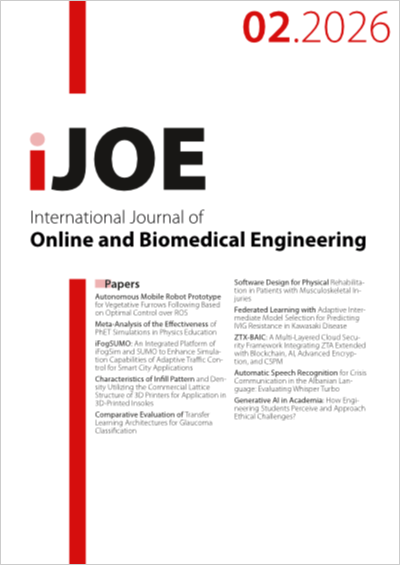
Generative AI in Academia: How Engineering Students Perceive and Approach Ethical Challenges?
DOI:
https://doi.org/10.3991/ijoe.v22i02.59281Keywords:
Generative Artificial Intelligence (GAI), Ethical Challenges, Digital Literacy, Students Perceptions, Engineering StudentsAbstract
Generative artificial intelligence (GAI) technologies have become increasingly prevalent in academic settings, offering students powerful tools for completing academic tasks. From drafting essays to solving complex problems, GAI enhances productivity and creativity, helping students streamline their learning. However, the rapid adoption of these tools raises essential ethical concerns regarding academic integrity, dependency, and the development of critical cognitive skills. This study explores how engineering students perceive and navigate the ethical challenges of GAI use in educational environments. Through a combination of quantitative survey data and qualitative open-ended responses collected via Google Forms, the research investigates students’ awareness of institutional policies, their views on academic honesty, and the implications of GAI for their learning practices. The study reveals a significant gap in students’ understanding of ethical guidelines, with many uncertain about when and how to disclose their use of GAI tools. It highlights the need for more precise institutional policies and for integrating digital literacy programs that address the benefits and risks of GAI use. Furthermore, the study emphasizes the importance of fostering responsible usage by educators and institutions, promoting balanced engagement with GAI tools to enhance learning without compromising the development of critical thinking, creativity, and independent problem-solving skills. The findings suggest that with proper guidance and policy adaptation, GAI can be a valuable resource in academia while preserving the integrity of the educational process.
References
[1] V. J. Owan, K. B. Abang, D. O. Idika, E. O. Etta, and B. A. Bassey, “Exploring the potential of artificial intelligence tools in educational measurement and assessment,” Eurasia J. Math. Sci. Technol. Educ., vol. 19, no. 8, 2023, doi: 10.29333/ejmste/13428.
[2] O. Ali, P. A. Murray, M. Momin, Y. K. Dwivedi, and T. Malik, “The effects of artificial intelligence applications in educational settings: Challenges and strategies,” Technol. Forecast. Soc. Change, vol. 199, no. June 2023, p. 123076, 2024, doi: 10.1016/j.techfore.2023.123076.
[3] R. Bommasani et al., “On the Opportunities and Risks of Foundation Models,” pp. 1–214, 2021.
[4] Y. Xu et al., “Artificial intelligence: A powerful paradigm for scientific research,” Innovation, vol. 2, no. 4, 2021, doi: 10.1016/j.xinn.2021.100179.
[5] J. Rudolph, S. Tan, and S. Tan, “ChatGPT: Bullshit spewer or the end of traditional assessments in higher education?,” J. Appl. Learn. Teach., vol. 6, no. 1, pp. 342–363, 2023, doi: 10.37074/jalt.2023.6.1.9.
[6] P. S. Bhullar, “ChatGPT in higher education - a synthesis of the literature and a future research agenda,” Educ. Inf. Technol., vol. 29, pp. 21501–21522, 2024.
[7] M. Javaid, A. Haleem, and R. P. Singh, “ChatGPT for healthcare services: An emerging stage for an innovative perspective,” BenchCouncil Trans. Benchmarks, Stand. Eval., vol. 3, no. 1, p. 100105, 2023, doi: 10.1016/j.tbench.2023.100105.
[8] C. Wienrich and M. E. Latoschik, “eXtended Artificial Intelligence: New Prospects of Human-AI Interaction Research,” Front. Virtual Real., vol. 2, pp. 1–30, 2021, doi: 10.3389/frvir.2021.686783.
[9] H. A. Mustofa, M. R. Bilad, and N. W. B. Grendis, “Utilizing AI for Physics Problem Solving: A Literature Review and ChatGPT Experience,” Lensa J. Kependidikan Fis., vol. 12, no. 1, p. 78, 2024, doi: 10.33394/j-lkf.v12i1.11748.
[10] L. Boussioux, J. N. Lane, M. Zhang, V. Jacimovic, and K. R. Lakhani, “The Crowdless Future? Generative AI and Creative Problem-Solving,” Organ. Sci., no. August, 2024, doi: 10.1287/orsc.2023.18430.
[11] X. Zhou, D. Teng, and H. Al-samarraie, “The Mediating Role of Generative AI Self-Regulation on Students ’ Critical The Mediating Role of Generative AI Self-Regulation on Students ’ Critical Thinking and Problem-Solving,” Educ. Sci., vol. 14, no. November, 2024, doi: 10.3390/educsci14121302.
[12] V. Capraro et al., “The impact of generative artificial intelligence on socioeconomic inequalities and policy making,” PNAS Nexus, vol. 3, no. 6, 2024, doi: 10.1093/pnasnexus/pgae191.
[13] T. Farrelly and N. Baker, “Generative Artificial Intelligence: Implications and Considerations for Higher Education Practice,” Educ. Sci., vol. 13, no. 11, 2023, doi: 10.3390/educsci13111109.
[14] Y. Jin, L. Yan, V. Echeverria, D. Gašević, and R. Martinez-Maldonado, “Generative AI in Higher Education: A Global Perspective of Institutional Adoption Policies and Guidelines,” Comput. Educ. Artif. Intell., vol. 8, no. December 2024, p. 100348, 2024, doi: 10.1016/j.caeai.2024.100348.
[15] D. Lee et al., “The impact of generative AI on higher education learning and teaching: A study of educators’ perspectives,” Comput. Educ. Artif. Intell., vol. 6, no. March, p. 100221, 2024, doi: 10.1016/j.caeai.2024.100221.
[16] A. Radtke and N. Rummel, “Generative AI in academic writing: Does information on authorship impact learners’ revision behavior?,” Comput. Educ. Artif. Intell., vol. 2, no. December, 2024, doi: 10.1016/j.caeai.2024.100350.
[17] J. Batista, A. Mesquita, and G. Carnaz, “Generative AI and Higher Education: Trends, Challenges, and Future Directions from a Systematic Literature Review,” Inf., vol. 15, no. 11, 2024, doi: 10.3390/info15110676.
[18] B. L. Moorhouse, M. A. Yeo, and Y. Wan, “Generative AI tools and assessment: Guidelines of the world’s top-ranking universities,” Comput. Educ. Open, vol. 5, no. July, p. 100151, 2023, doi: 10.1016/j.caeo.2023.100151.
[19] S. A. Chauncey and H. P. McKenna, “A framework and exemplars for ethical and responsible use of AI Chatbot technology to support teaching and learning,” Comput. Educ. Artif. Intell., vol. 5, no. August, p. 100182, 2023, doi: 10.1016/j.caeai.2023.100182.
[20] M. Pumptow and T. Brahm, “Higher education students differ in their technology use,” Comput. Educ. Open, vol. 5, no. December 2022, p. 100149, 2023, doi: 10.1016/j.caeo.2023.100149.
[21] B. M. Mutanga, M. Lecheko, and Z. Revesai, “Navigating the Grey Area: Students’ Ethical Dilemmas in Using AI Tools for Coding Assignments,” IJIE (Indonesian J. Informatics Educ., vol. 8, no. 1, p. 15, 2024, doi: 10.20961/ijie.v8i1.90385.
[22] B. G. Acosta-Enriquez et al., “Knowledge, attitudes, and perceived Ethics regarding the use of ChatGPT among generation Z university students,” Int. J. Educ. Integr., vol. 20, no. 1, pp. 1–23, 2024, doi: 10.1007/s40979-024-00157-4.
[23] M. Liu, Y. Ren, L. M. Nyagoga, F. Stonier, Z. Wu, and L. Yu, “Future of education in the era of generative artificial intelligence: Consensus among Chinese scholars on applications of ChatGPT in schools,” Futur. Educ. Res., vol. 1, no. 1, pp. 72–101, 2023, doi: 10.1002/fer3.10.
[24] A. Nguyen, H. N. Ngo, Y. Hong, B. Dang, and B. P. T. Nguyen, “Ethical principles for artificial intelligence in education,” Educ. Inf. Technol., vol. 28, no. 4, pp. 4221–4241, 2023, doi: 10.1007/s10639-022-11316-w.
[25] K. P. Dela Calzada, “Anti-dependency teaching strategy for innovation in the age of AI among technology-based students,” Environ. Soc. Psychol., vol. 9, no. 8, pp. 1–18, 2024, doi: 10.59429/esp.v9i8.3026.
[26] C. K. Lo, “What Is the Impact of ChatGPT on Education? A Rapid Review of the Literature,” Educ. Sci., vol. 13, no. 4, 2023, doi: 10.3390/educsci13040410.
[27] A. Duane, “Can Artificial Intelligence Complete My Assessment? A Student Led Initiative to Stress Test the Academic Integrity of University Assessment Using Generative AI,” Int. Conf. High. Educ. Adv., no. June, pp. 10–17, 2024, doi: 10.4995/HEAd24.2024.17143.
[28] B. N. Obenza, A. Salvahan, A. N. Rios, and A. Solo, “University Students’ Perception and Use of ChatGPT: Generative Artificial Intelligence (AI) in Higher Education Article in,” Int. J. Hum. Comput. Stud., vol. 5, no. 12, pp. 5–18, 2023, doi: 10.31149/ijhcs.v5i12.5033.
[29] M. R. Raza and W. Hussain, “Preserving Academic Integrity in Teaching with ChatGPT: Practical Strategies,” Proc. - 2023 22nd IEEE/WIC Int. Conf. Web Intell. Intell. Agent Technol. WI-IAT 2023, no. January, pp. 158–162, 2023, doi: 10.1109/WI-IAT59888.2023.00027.
[30] M. Sallam et al., “ChatGPT Usage and Attitudes are Driven by Perceptions of Usefulness, Ease of Use, Risks, and Psycho-Social Impact: A Study among University Students in the UAE,” Front. Educ., vol. 9, no. August, p. 1414758, 2024, doi: 10.3389/feduc.2024.1414758.
[31] A. Ateeq, M. Alzoraiki, M. Milhem, and R. A. Ateeq, “Artificial intelligence in education: implications for academic integrity and the shift toward holistic assessment,” Front. Educ., vol. 9, no. October, pp. 1–11, 2024, doi: 10.3389/feduc.2024.1470979.
[32] Y. Jin, L. Yan, V. Echeverria, D. Gašević, and R. Martinez-Maldonado, “Generative AI in Higher Education: A Global Perspective of Institutional Adoption Policies and Guidelines,” Comput. Educ. Artif. Intell., vol. 8, pp. 1–16, 2025, doi: 10.1016/j.caeai.2024.100348.
[33] Z. Bahroun, C. Anane, and V. Ahmed, “Transforming Education : A Comprehensive Review of Generative Artificial Intelligence in Educational Settings through Bibliometric and Content Analysis,” 2023.
[34] E. Çela, M. Fonkam, and R. M. Potluri, “Risks of AI-Assisted Learning on Student Critical Thinking :,” Int. J. Risk Contigency Manag., vol. 12, no. 1, pp. 1–19, 2024, doi: 10.4018/IJRCM.350185.
[35] A. Darvishi, H. Khosravi, S. Sadiq, D. Gasevic, and G. Siemens, “Computers & Education Impact of AI assistance on student agency,” Comput. Educ., vol. 210, no. November 2023, 2024, doi: 10.1016/j.compedu.2023.104967.
[36] S. Wang, F. Wang, Z. Zhu, J. Wang, T. Tran, and Z. Du, “Artificial intelligence in education : A systematic literature review,” Expert Syst. Appl., vol. 252, no. PA, p. 124167, 2024, doi: 10.1016/j.eswa.2024.124167.
[37] Y. Fu and Z. Weng, “Computers and Education : Artificial Intelligence Navigating the ethical terrain of AI in education : A systematic review on framing responsible human-centered AI practices,” Comput. Educ. Artif. Intell., vol. 7, no. August 2023, p. 100306, 2024, doi: 10.1016/j.caeai.2024.100306.
[38] M. Nyaaba and P. Kyeremeh, “Generative AI in Academic Research : A Descriptive Study on Awareness , Gender Usage , and Views among Pre-Service Teachers,” no. April, 2024, doi: 10.61969/jai.1400867.
[39] R. Cacho, “Integrating Generative AI in University Teaching and Learning : A Model for Balanced Guidelines,” no. September, 2024, doi: 10.24059/olj.v28i3.4508.
[40] G. Baxter and T. Hainey, “Student perceptions of virtual reality use in higher education,” J. Appl. Res. High. Educ., vol. 12, no. 3, pp. 413–424, 2020, doi: 10.1108/JARHE-06-2018-0106.
[41] S. Grassini, “Shaping the Future of Education: Exploring the Potential and Consequences of AI and ChatGPT in Educational Settings,” Educ. Sci., vol. 13, no. 7, 2023, doi: 10.3390/educsci13070692.
[42] N. L. Rane, S. Shirke, S. P. Choudhary, and J. Rane, “Education Strategies for Promoting Academic Integrity in the Era of Artificial Intelligence and ChatGPT : Ethical Considerations , Challenges , Policies , and Future Directions,” vol. 1, no. 1, pp. 36–59, 2024.
[43] P. Gupta, B. Ding, C. Guan, and D. Ding, “Generative AI: A systematic review using topic modelling techniques,” Data Inf. Manag., vol. 8, no. 2, p. 100066, 2024, doi: 10.1016/j.dim.2024.100066.
[44] M. Hernandez-de-Menendez, C. Escobar Díaz, and R. Morales-Menendez, “Technologies for the future of learning: state of the art,” Int. J. Interact. Des. Manuf., vol. 14, no. 2, pp. 683–695, 2020, doi: 10.1007/s12008-019-00640-0.
[45] . R. Khan, Handbook of Academic Integrity, no. July 2023. 2015.
[46] N. Hadinejad, “DEPARTMENT OF EDUCATION AND SPECIAL EDUCATION ETHICAL CONSIDERATIONS OF THE DIGITAL AGE IN HIGHER EDUCATION : An Interview-based Study of Student Experiences with ChatGPT as an Example of Generative AI,” 2024.
[47] H. Benouachane, “AI in Higher Education: Balancing Pedagogical Benefits and Ethical Challenges,” Sci. Step J., vol. 2, no. 5, 2024, doi: 10.6084/m9.figshare.26349289.
[48] A. Dabis and C. Csáki, “AI and ethics: Investigating the first policy responses of higher education institutions to the challenge of generative AI,” Humanit. Soc. Sci. Commun., vol. 11, no. 1, pp. 1–13, 2024, doi: 10.1057/s41599-024-03526-z.
[49] S. Plata, M. A. De Guzman, and A. Quesada, “Emerging Research and Policy Themes on Academic Integrity in the Age of Chat GPT and Generative AI,” Asian J. Univ. Educ., vol. 19, no. 4, pp. 743–758, 2023, doi: 10.24191/ajue.v19i4.24697.
[50] L. Ma and D. Zhao, “Prospects and Ethical Considerations of Generative Artificial Intelligence in Higher Education,” SHS Web Conf., vol. 187, p. 03030, 2024, doi: 10.1051/shsconf/202418703030.
[51] U. Mittal, S. Sai, V. Chamola, and Devika, “A Comprehensive Review on Generative AI for Education,” IEEE Access, no. August, 2024, doi: 10.1109/ACCESS.2024.3468368.
[52] S. Sok and K. Heng, “Opportunities, challenges, and strategies for using ChatGPT in higher education: A literature review,” J. Digit. Educ. Technol., vol. 4, no. 1, p. ep2401, 2023, doi: 10.30935/jdet/14027.
[53] C. K. Y. Chan and W. Hu, “Students’ voices on generative AI: perceptions, benefits, and challenges in higher education,” Int. J. Educ. Technol. High. Educ., vol. 20, no. 1, 2023, doi: 10.1186/s41239-023-00411-8.
[54] M. Nadal, G. Corradi, J. R. Barrada, A. Clemente, and E. G. Chuquichambi, “Reply to Myszkowski et al. (2020): Some matters of fact concerning aesthetic sensitivity,” Br. J. Psychol., vol. 111, no. 4, pp. 663–664, 2020, doi: 10.1111/bjop.12443.
[55] A. W. Ou, B. Khuder, S. Franzetti, and R. Negretti, “Conceptualising and cultivating Critical GAI Literacy in doctoral academic writing,” J. Second Lang. Writ., vol. 66, no. November, 2024, doi: 10.1016/j.jslw.2024.101156.
[56] S. Karkoulian, N. Sayegh, and N. Sayegh, “ChatGPT Unveiled: Understanding Perceptions of Academic Integrity in Higher Education - A Qualitative Approach,” J. Acad. Ethics, 2024, doi: 10.1007/s10805-024-09543-6.
[57] N. M. Abdelaal and I. Al Sawi, “Perceptions, Challenges, and Prospects: University Professors’ Use of Artificial Intelligence in Education,” Aust. J. Appl. Linguist., vol. 7, no. 1, 2024, doi: 10.29140/ajal.v7n1.1309.
[58] R. Kaplan-Rakowski, K. Grotewold, P. Hartwick, and K. Papin, “Generative AI and Teachers’ Perspectives on Its Implementation in Education,” J. Interact. Learn. Res., vol. 34, no. 2, pp. 313–338, 2023.
[59] H. Warpefelt and H. Verhagen, “A model of non-player character believability,” J. Gaming Virtual Worlds, vol. 9, no. 1, pp. 39–53, 2017, doi: 10.1386/jgvw.9.1.39_1.
[60] A. Das, S. Malaviya, and M. Singh, “The Impact of AI-Driven Personalization on Learners’ Performance,” Artic. Int. J. Comput. Sci. Eng., vol. 11, no. 8, pp. 15–22, 2023, doi: 10.26438/ijcse/v11i8.1522.
[61] C. Hervás-gómez, C. Hervás-gómez, and M. D. Díaz-noguera, The Education Revolution through Artificial Intelligence Enhancing Skills , no. November. 2024.
[62] A. M. Musyaffi, M. A. Adha, H. Mukhibad, and M. C. Oli, “Improving students’ openness to artificial intelligence through risk awareness and digital literacy: Evidence form a developing country,” Soc. Sci. Humanit. Open, vol. 10, no. June, p. 101168, 2024, doi: 10.1016/j.ssaho.2024.101168.
[63] C. Börekci and Ö. Çelik, “Exploring The Role of Digital Literacy in University Students’ Engagement with AI through the Technology Acceptance Model,” Sak. Univ. J. Educ., no. July, 2024, doi: 10.19126/suje.1468866.
[64] M. J. T. Tan and N. M. A. T. Maravilla, “Shaping integrity: why generative artificial intelligence does not have to undermine education,” Front. Artif. Intell., vol. 7, no. 1785, 2024, doi: 10.3389/frai.2024.1471224.
[65] A. Haleem, M. Javaid, M. A. Qadri, and R. Suman, “Understanding the role of digital technologies in education: A review,” Sustain. Oper. Comput., vol. 3, no. May, pp. 275–285, 2022, doi: 10.1016/j.susoc.2022.05.004.
[66] E. Pantano, F. Serravalle, and C. V. Priporas, “The form of AI-driven luxury: how generative AI (GAI) and Large Language Models (LLMs) are transforming the creative process,” J. Mark. Manag., vol. 40, no. 17–18, pp. 1771–1790, 2024, doi: 10.1080/0267257X.2024.2436096.
[67] J. W. Creswell and J. D. Cresswell, Research Design: Qualitative, Quantitative, and Mixed Method Approaches, Fifth Edit. California: SAGE Publications, Inc, 2018.
[68] W. M. Lim, “What Is Qualitative Research? An Overview and Guidelines,” Australas. Mark. J., 2024, doi: 10.1177/14413582241264619.
[69] H. Snyder, “Literature review as a research methodology: An overview and guidelines,” J. Bus. Res., vol. 104, no. August, pp. 333–339, 2019, doi: 10.1016/j.jbusres.2019.07.039.
[70] L. Wolf et al., “Data accuracy, consistency and completeness of the national Swiss cystic fibrosis patient registry: Lessons from an ECFSPR data quality project,” J. Cyst. Fibros., vol. 23, no. 3, pp. 506–511, 2024, doi: 10.1016/j.jcf.2023.08.015.
[71] N. Guler, S. N. Kirshner, and R. Vidgen, “A literature review of artificial intelligence research in business and management using machine learning and ChatGPT,” Data Inf. Manag., vol. 8, no. 3, p. 100076, 2024, doi: 10.1016/j.dim.2024.100076.
[72] L. Salahange, J. Sánchez-Martín, M. A. Dávila-Acedo, and F. Cañada-Cañada, “A new validated instrument to assess sustainability perception among university students,” Discov. Sustain., vol. 5, no. 1, 2024, doi: 10.1007/s43621-024-00623-6.
[73] Y. Zhou, “A Mixed Methods Model of Scale Development and Validation Analysis,” Measurement, vol. 17, no. 1, pp. 38–47, 2019, doi: 10.1080/15366367.2018.1479088.
[74] K. Semyonov-Tal and N. Lewin-Epstein, “The importance of combining open-ended and closed-ended questions when conducting patient satisfaction surveys in hospitals,” Heal. Policy OPEN, vol. 2, no. December 2020, p. 100033, 2021, doi: 10.1016/j.hpopen.2021.100033.
[75] M. Mataji Amirroud, M. Ghaffari, A. Ramezankhani, and H. Soori, “Developing and validating an instrument to assess women’s empowerment in dealing with domestic violence in Iran: a mixed-methods study protocol,” BMJ Open, vol. 13, no. 8, pp. 1–7, 2023, doi: 10.1136/bmjopen-2023-073826.
[76] M. Nii Laryeafio and O. C. Ogbewe, “Ethical consideration dilemma: systematic review of ethics in qualitative data collection through interviews,” J. Ethics Entrep. Technol., vol. 3, no. 2, pp. 94–110, 2023, doi: 10.1108/jeet-09-2022-0014.
[77] H. Mirza, F. Bellalem, and C. Mirza, “Ethical Considerations in Qualitative Research: Summary Guidelines for Novice Social Science Researchers,” Soc. Stud. Res. J., vol. 11, no. 1, pp. 441–449, 2023.
[78] S. Elkefi, A. Tounsi, and M. A. Kefi, “Use of ChatGPT for education by engineering students in developing countries: a mixed-methods study,” Behav. Inf. Technol., no. July, pp. 1–17, 2024, doi: 10.1080/0144929X.2024.2354428.
[79] I. Întorsureanu, R. Voicu-Dorobanțu, C. F. Nisioiu, and C. Ploae, “Generative Artificial Intelligence and the Academic Integrity of Graduation Works in Economics–Exploring Perceptions of Romanian Academia,” Econ. Comput. Econ. Cybern. Stud. Res., vol. 58, no. 2, pp. 132–147, 2024, doi: 10.24818/18423264/58.2.24.08.
[80] M. Naeem, W. Ozuem, K. Howell, and S. Ranfagni, “A Step-by-Step Process of Thematic Analysis to Develop a Conceptual Model in Qualitative Research,” Int. J. Qual. Methods, vol. 22, no. October, pp. 1–18, 2023, doi: 10.1177/16094069231205789.
[81] H. Taherdoost, “What are Different Research Approaches? Comprehensive Review of Qualitative, Quantitative, and Mixed Method Research, Their Applications, Types, and Limitations,” J. Manag. Sci. Eng. Res., vol. 5, no. 1, pp. 53–63, 2022, doi: 10.30564/jmser.v5i1.4538.
[82] B. E. Neubauer, C. T. Witkop, and L. Varpio, “How phenomenology can help us learn from the experiences of others,” Perspect. Med. Educ., vol. 8, no. 2, pp. 90–97, 2019, doi: 10.1007/s40037-019-0509-2.
[83] L. S. Nowell, J. M. Norris, D. E. White, and N. J. Moules, “Thematic Analysis: Striving to Meet the Trustworthiness Criteria,” Int. J. Qual. Methods, vol. 16, no. 1, pp. 1–13, 2017, doi: 10.1177/1609406917733847.
[84] M. K. W. Stranges, S. Ul Haq, and D. G. Dunn, “Black-out test versus UV camera for corona inspection of HV motor stator endwindings,” IEEE Trans. Ind. Appl., vol. 50, no. 5, pp. 3135–3140, 2014, doi: 10.1109/TIA.2014.2306979.
[85] C. R. Lochmiller, “Conducting thematic analysis with qualitative data,” Qual. Rep., vol. 26, no. 6, pp. 2029–2044, 2021, doi: 10.46743/2160-3715/2021.5008.
[86] G. van den Berg, “Generative AI and Educators: Partnering in Using Open Digital Content for Transforming Education,” Open Prax., vol. 16, no. 2, pp. 130–141, 2024, doi: 10.55982/openpraxis.16.2.640.
[87] R. Mulenga and H. Shilongo, “Academic Integrity in Higher Education: Understanding and Addressing Plagiarism,” Acta Pedagog. Asiana, vol. 3, no. 1, pp. 30–43, 2024, doi: 10.53623/apga.v3i1.337.
[88] W. Shafik, The Role of Generative Artificial Intelligence in E-Commerce Fraud Detection and Prevention, no. Seaa. Atlantis Press SARL, 2024.
[89] L. Hendren and K. Kuzmeskas, “Health Nexus,” no. November 2022, pp. 0–26, 2017.
[90] M. Farrokhnia, S. K. Banihashem, O. Noroozi, and A. Wals, “A SWOT analysis of ChatGPT: Implications for educational practice and research,” Innov. Educ. Teach. Int., vol. 61, no. 3, pp. 460–474, 2024, doi: 10.1080/14703297.2023.2195846.
[91] P. Nedungadi, K. Y. Tang, and R. Raman, “The Transformative Power of Generative Artificial Intelligence for Achieving the Sustainable Development Goal of Quality Education,” Sustain., vol. 16, no. 22, pp. 1–27, 2024, doi: 10.3390/su16229779.
[92] W. Murikah, J. K. Nthenge, and F. M. Musyoka, “Bias and ethics of AI systems applied in auditing - A systematic review,” Sci. African, vol. 25, p. e02281, 2024, doi: 10.1016/j.sciaf.2024.e02281.
[93] E. Ferrara, “Fairness and Bias in Artificial Intelligence: A Brief Survey of Sources, Impacts, and Mitigation Strategies,” Sci, vol. 6, no. 1, 2024, doi: 10.3390/sci6010003.
[94] G. Kurtz et al., “Strategies for Integrating Generative AI into Higher Education: Navigating Challenges and Leveraging Opportunities,” Educ. Sci., vol. 14, no. 5, 2024, doi: 10.3390/educsci14050503.
[95] D. Tweedie, M. C. Dyball, J. Hazelton, and S. Wright, “Teaching Global Ethical Standards: A Case and Strategy for Broadening the Accounting Ethics Curriculum,” J. Bus. Ethics, vol. 115, no. 1, pp. 1–15, 2013, doi: 10.1007/s10551-012-1364-9.
[96] P. Jiao, F. Ouyang, Q. Zhang, and A. H. Alavi, “Artificial intelligence-enabled prediction model of student academic performance in online engineering education,” Artif. Intell. Rev., vol. 55, no. 8, pp. 6321–6344, 2022, doi: 10.1007/s10462-022-10155-y.
[97] S. O’Connor, N. Gasteiger, E. Stanmore, D. C. Wong, and J. J. Lee, “Artificial intelligence for falls management in older adult care: A scoping review of nurses’ role,” J. Nurs. Manag., vol. 30, no. 8, pp. 3787–3801, 2022, doi: 10.1111/jonm.13853.
[98] C. K. Bala et al., “Generative Artificial Intelligence for Education and Pedagogy,” p. 35, 2023.
[99] T. Lim, S. Gottipati, and M. L. F. Cheong, Ethical considerations for artificial intelligence in educational assessments, no. January 2024. 2023.
[100] OECD, Equity and Inclusion in Education: Finding Strenght through Diversity. 2023.
[101] H. Johnston, R. F. Wells, E. M. Shanks, T. Boey, and B. N. Parsons, “Student perspectives on the use of generative artificial intelligence technologies in higher education,” Int. J. Educ. Integr., vol. 20, no. 1, pp. 1–21, 2024, doi: 10.1007/s40979-024-00149-4.
[102] M. A. R. Vasconcelos and R. P. dos Santos, “Enhancing STEM learning with ChatGPT and Bing Chat as objects to think with: A case study,” Eurasia J. Math. Sci. Technol. Educ., vol. 19, no. 7, 2023, doi: 10.29333/ejmste/13313.
[103] J. van Niekerk, P. M. J. Delport, and I. Sutherland, “Addressing the use of generative AI in academic writing,” Comput. Educ. Artif. Intell., vol. 8, no. June 2024, p. 100342, 2025, doi: 10.1016/j.caeai.2024.100342.
[104] J. E. Duah and P. McGivern, “How generative artificial intelligence has blurred notions of authorial identity and academic norms in higher education, necessitating clear university usage policies,” Int. J. Inf. Learn. Technol., vol. 41, no. 2, pp. 180–193, 2024, doi: 10.1108/IJILT-11-2023-0213.
[105] X. Lin, R. Y. Chan, S. Sharma, and K. Bista, ChatGPT and Global Higjer Education Using Artificial Intelligence in Teaching and Learning. Washington: Star Scholars Network, 2024.
[106] C. Zhang and Lizelle E. Villanueva, “Generative Artificial Intelligence Preparedness and Technological Competence,” Int. J. Educ. Humanit., vol. 11, no. 2, pp. 164–170, 2023, doi: 10.54097/ijeh.v11i2.13753.
[107] S. Kılınç, “Embracing the Future of Distance Science Education: Opportunities and Challenges of ChatGPT Integration,” Asian J. Distance Educ. Kılınç, vol. 18, no. 1, pp. 205–237, 2023, doi: 10.5281/zenodo.7857396.
[108] P. Awad and S. Oueida, “The Potential Impact of Artificial Intelligence on Education: Opportunities and Challenges,” Lect. Notes Networks Syst., vol. 920 LNNS, no. 23, pp. 566–575, 2024, doi: 10.1007/978-3-031-53963-3_39.
[109] J. Bairstow and A. Heng, “Innovative Learning with Generative AI : Addressing Implementation Innovative Learning with Generative AI : Addressing Implementation Challenges,” no. May, 2024, doi: 10.13140/RG.2.2.14760.38403.
[110] Y. Da Chen and R. Sharma, “Bridging AI and Education: Strategies for Overcoming Generative AI Challenges,” no. May, 2024, doi: 10.13140/RG.2.2.20632.40964.
[111] R. Jack and A. Heng, “Generative AI in the Classroom: Overcoming Challenges for Effective Teaching,” Researchgate.Net, no. May, 2024, doi: 10.13140/RG.2.2.24826.71367.
[112] T. Graepel and H. Ali, “Educational Revolution: Overcoming Challenges in Generative AI Adoption,” no. May, 2024, doi: 10.13140/RG.2.2.32376.46087.
[113] A. Heng and R. Nikolas, “Adapting to the AI Educational Landscape: Challenges of Generative AI Integration,” no. May, 2024, doi: 10.13140/RG.2.2.34893.04320.
[114] Y. Da Chen and M. Jarrey, “Evolving Teaching Practices: Addressing Challenges of Generative AI Integration,” no. May, 2024, doi: 10.13140/RG.2.2.34054.18245.
[115] J. Rowley, “Knowledge management in pursuit of learning: The Learning with Knowledge Cycle,” J. Inf. Sci., vol. 27, no. 4, pp. 227–237, 2001, doi: 10.1177/016555150102700406.
[116] S. Hughes, “The AI Revolution & Higher Education: Why 21st Century Durable Skills Are Needed More Than Ever,” vol. 9, no. May, pp. 2–45, 2023, doi: 10.13140/RG.2.2.27825.66406.
[117] D. K. Kanbach, L. Heiduk, G. Blueher, M. Schreiter, and A. Lahmann, The GenAI is out of the bottle: generative artificial intelligence from a business model innovation perspective, vol. 18, no. 4. Springer Berlin Heidelberg, 2024.
Downloads
Published
How to Cite
Issue
Section
License
Copyright (c) 2025 Didik Hariyanto, Arif Ainur Rafiq, Mochamad Bruri Triyono, Dewi Eka Murniati, Dina Adinda, Tinesa Fara Prihandini

This work is licensed under a Creative Commons Attribution 4.0 International License.