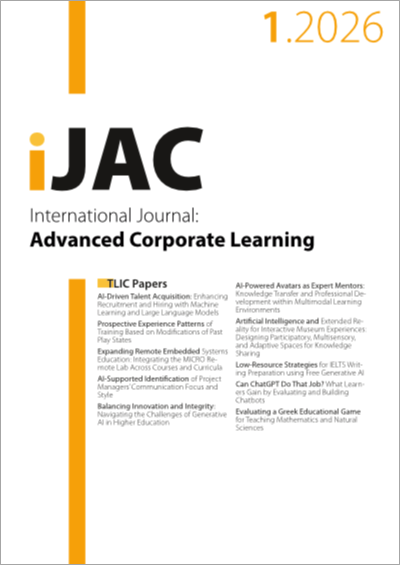
Can ChatGPT Do That Job?
What Learners Gain by Evaluating and Building Chatbots
DOI:
https://doi.org/10.3991/ijac.v19i1.58913Keywords:
AI in Education, Philosophy of Education, Teacher Education, Custom Chatbots, Student-centered learningAbstract
This article examines two connected projects that positioned students as active participants in their engagement with large language model chatbots. In one, students acted as evaluators, testing chatbots in assigned educational roles and reflecting on their strengths and limitations. In the second, students acted as builders, designing custom bots for specific purposes and exchanging feedback with peers. Across both, the emphasis was on student-centered learning, where learners were not passive users of technology but decision-makers shaping its applications. The findings suggest broader relevance beyond higher education. The evaluator–builder dynamic offers a framework for adult learning and workplace training, where employees can benefit from opportunities to evaluate existing tools, build simple role-based versions for their own tasks, and reflect on outcomes alongside ethical concerns. These projects suggest that effectiveness, in both classrooms and workplaces, may depend less on technical capability alone and more on how learners are empowered to engage with, adapt, and take responsibility for these tools.
References
[1] C. Silva Sibilin, “Education and the epistemological crisis in the age of ChatGPT,” Critical Review, vol. 35, no. 4, pp. 414–425, Nov. 2023, doi: 10.1080/08913811.2023.2284042.
[2] J. A. Bowen and C. E. Watson, Teaching with AI: A Practical Guide to a New Era of Human Learning. Baltimore, MD, USA: Johns Hopkins Univ. Press, 2024.
[3] J. White et al., “A prompt pattern catalog to enhance prompt engineering with ChatGPT,” arXiv, arXiv:2302.11382, 2023.
Downloads
Published
How to Cite
Issue
Section
License
Copyright (c) 2026 Casandra Silva Sibilin

This work is licensed under a Creative Commons Attribution 4.0 International License.