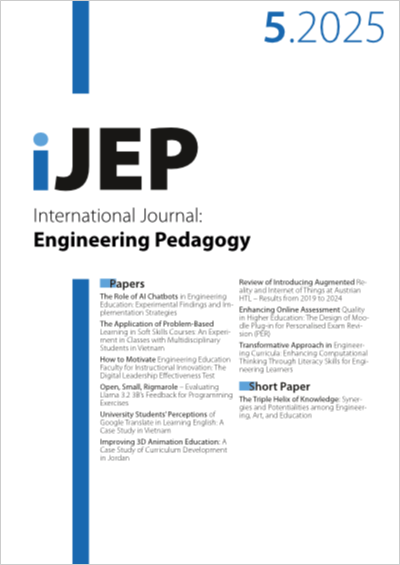
University Students’ Perceptions of Google Translate in Learning English: A Case Study in Vietnam
DOI:
https://doi.org/10.3991/ijep.v15i5.54013Keywords:
Technology Acceptance Model, Google Translate, learning English, students’ perceptionsAbstract
This study investigates Vietnamese university students’ perceptions of Google translate (GT) in English language learning using the technology acceptance model (TAM). The research examines three key constructs: Perceived ease of use (PEOU), perceived usefulness (PU), and behavioral intention (BI). It explores the relationships among them. Data collected from 535 students from a university in Vietnam revealed high levels of acceptance, with strong correlations among the TAM constructs. Female students reported significantly higher levels of PEOU, PU, and BI compared to males, highlighting gender-based differences in perceptions, while no significant differences were observed between first- and second-year students. These findings underscore the potential of GT as a supplementary tool in English-as-a-foreign-language (EFL) learning, enhancing user engagement and academic outcomes. However, overreliance on the tool may hinder critical language skill development, emphasizing the need for guided integration. Practical recommendations include training sessions on effective usage and gender-sensitive pedagogical interventions. Limitations of the study include its focus on a single institution and reliance on self-reported data, suggesting the need for broader, multi-institutional studies and qualitative approaches in future research. The findings contribute to the literature on technology acceptance in language education, providing valuable insights for optimizing GT’s role in EFL learning.
Downloads
Published
How to Cite
Issue
Section
License
Copyright (c) 2025 Duc Thuan Pham

This work is licensed under a Creative Commons Attribution 4.0 International License.